Strategic Trends in Data Quality: From AI Innovation to Scalable Trust in 2026
High-quality data is more than a benchmark – it is a strategic necessity for global trust, compliance and interoperability. In this blog, Zornitsa Manolova, Head of Data Quality Management and Data Science at GLEIF, explores the key trends that are helping to build a more transparent global economy.
Author: Zornitsa Manolova
Date: 2026-01-08
Views:
In an increasingly interconnected global economy, the ability for organizations to trust and use data effectively is the foundation for innovation, growth, and competitiveness.
A high-quality data ecosystem is a driver of change and innovation, enabling organizations to identify and seize new opportunities. At the same time, low data quality can lead to inefficiencies and expose the organization to regulatory and reputational risks.
GLEIF is committed to optimizing the quality, reliability, and usability of LEI data. Since 2017, it has published dedicated monthly reports to transparently demonstrate the overall level of data quality achieved in the Global LEI System.
To aid broader industry understanding and awareness of GLEIF’s data quality initiatives, this new blog series explores key metrics included within the reports.
This month’s blog reviews key achievements of the past year and outlines what is to come in 2026.
As we close out the 2025 reporting year, it is a valuable opportunity to reflect on the progress across the Global LEI System and look ahead to what’s next.
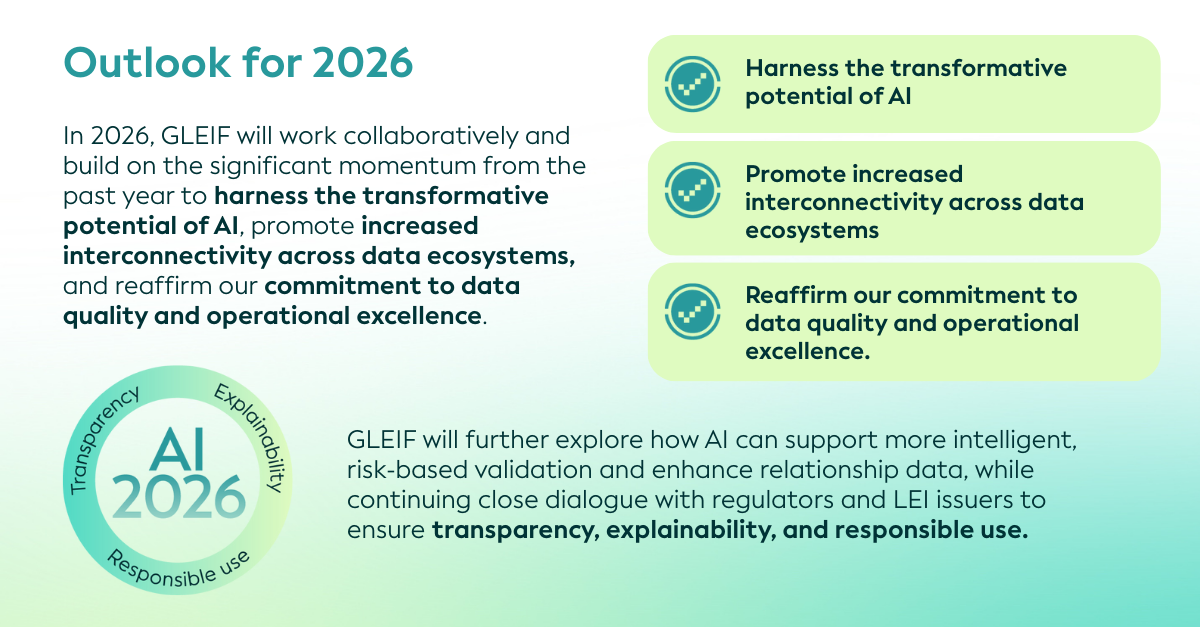
In 2026, GLEIF will work collaboratively and build on the significant momentum from the past year to harness the transformative potential of AI, promote increased interconnectivity across data ecosystems, and reaffirm our commitment to data quality and operational excellence:
Promoting AI Innovation
A key priority for GLEIF is exploring how AI can enable practical innovation that strengthens trust in the Global LEI System.
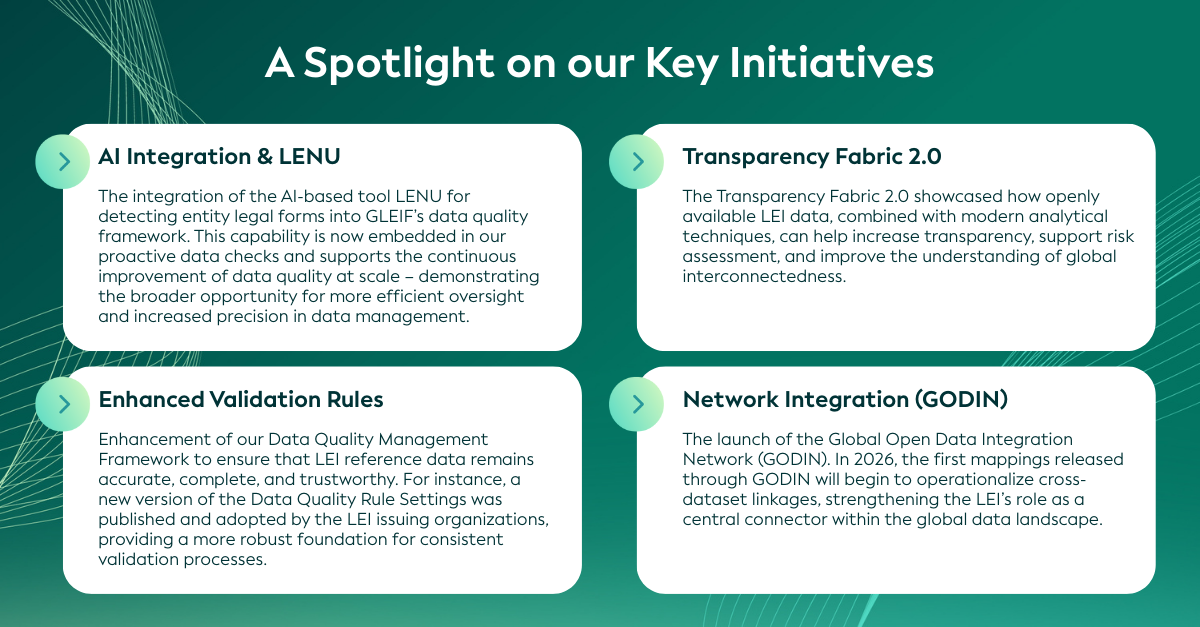
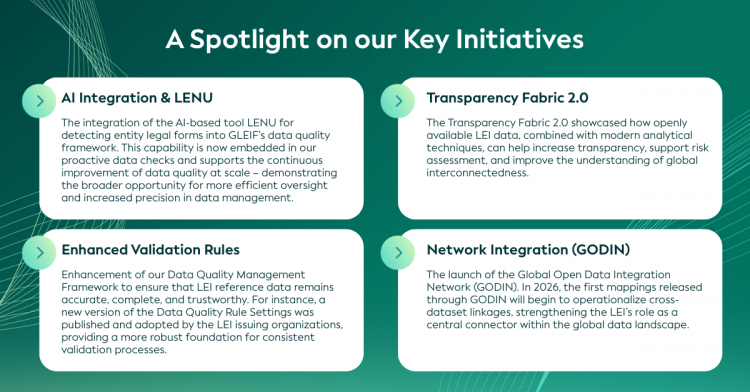
The integration of the AI-based tool LENU for detecting entity legal forms into GLEIF’s data Quality framework was a significant milestone in 2025. This capability is now embedded in our proactive data checks. It supports continuous improvement in data quality at scale, demonstrating broader opportunities for more efficient oversight and greater precision in data management.
As we move into 2026, GLEIF will continue to explore how AI can enhance data quality checks, including more intelligent validation logic and more adaptive, risk-based approaches. We will also explore deeper options for leveraging AI to enhance relationship information and improve understanding of interconnectedness across datasets.
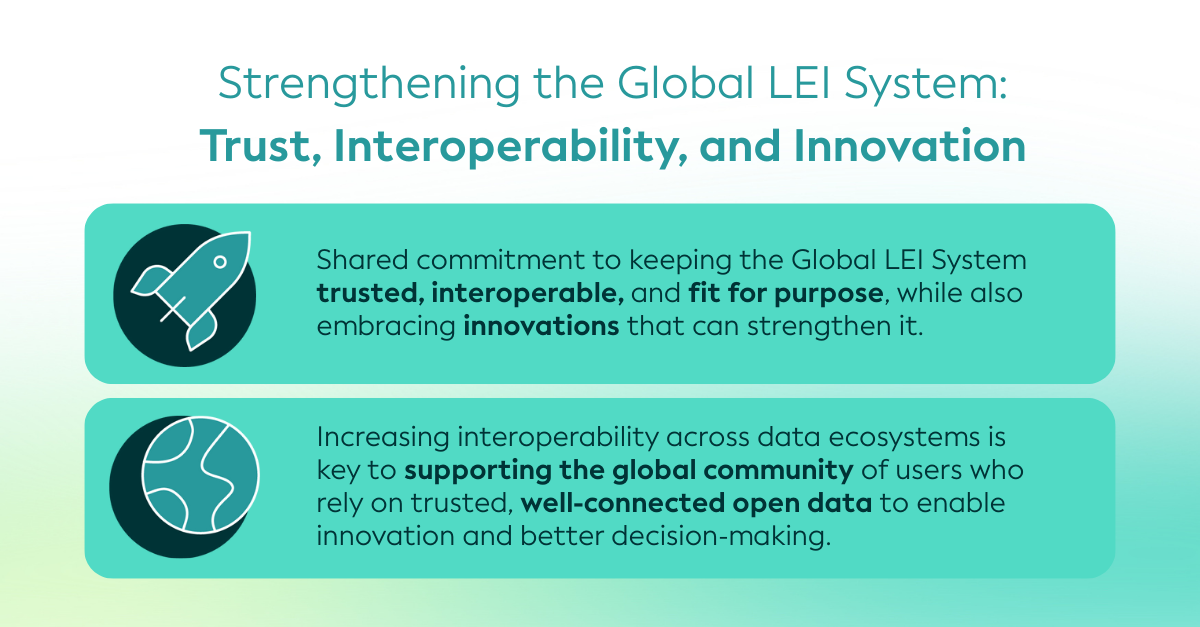
This will be informed by continued collaboration. In November 2025, members of the Regulatory Oversight Committee (ROC), GLEIF, and the LEI issuer community came together for an open and forward-looking exchange on AI. The discussions explored where AI can already add value today, from improving data quality and validation to supporting more efficient operations and user experiences, and where we must be thoughtful and deliberate as the technology evolves. These discussions reflected a shared commitment to keeping the Global LEI System trusted, interoperable, and fit for purpose, while also embracing innovations that can strengthen it.
Increasing interoperability across data ecosystems
Increasing interoperability across data ecosystems is key to supporting the global community of users who rely on trusted, well-connected open data to enable innovation and better decision-making.
In recognition of this need, GLEIF was pleased to participate in the BIS Innovation Hub’s Analytics Challenge, which focused on leveraging open data and advanced analytics for the public good. Our contribution – The Transparency Fabric 2.0 – showcased how openly available LEI data, combined with modern analytical techniques, can increase transparency, support risk assessment, and enhance understanding of global interconnectedness.
Our experience building the Transparency Fabric 2.0 also demonstrated that scaling transparency requires even broader cooperation across trusted open data sources. This is why we also launched the Global Open Data Integration Network (GODIN). GODIN aims to connect well-governed, publicly available datasets from reliable sources and link them to the LEI. By strengthening interoperability and enabling richer insights across jurisdictions, GODIN reinforces the LEI's role as a central connector in the global data landscape. In 2026, the first mappings will be released through GODIN, with network development and expansion continuing throughout the year, and additional mappings planned for release.
Strengthening data quality and driving operational excellence
Crucially, our work to promote innovation and interoperability across the Global LEI System will be underpinned by our enduring commitment to data quality and operational excellence.
In 2025, we continued to enhance our Data Quality Management Framework to ensure that LEI reference data remains accurate, complete, and trustworthy. For instance, a new version of the Data Quality Rule Settings was published and adopted by LEI-issuing organizations, providing a more robust foundation for consistent validation processes.
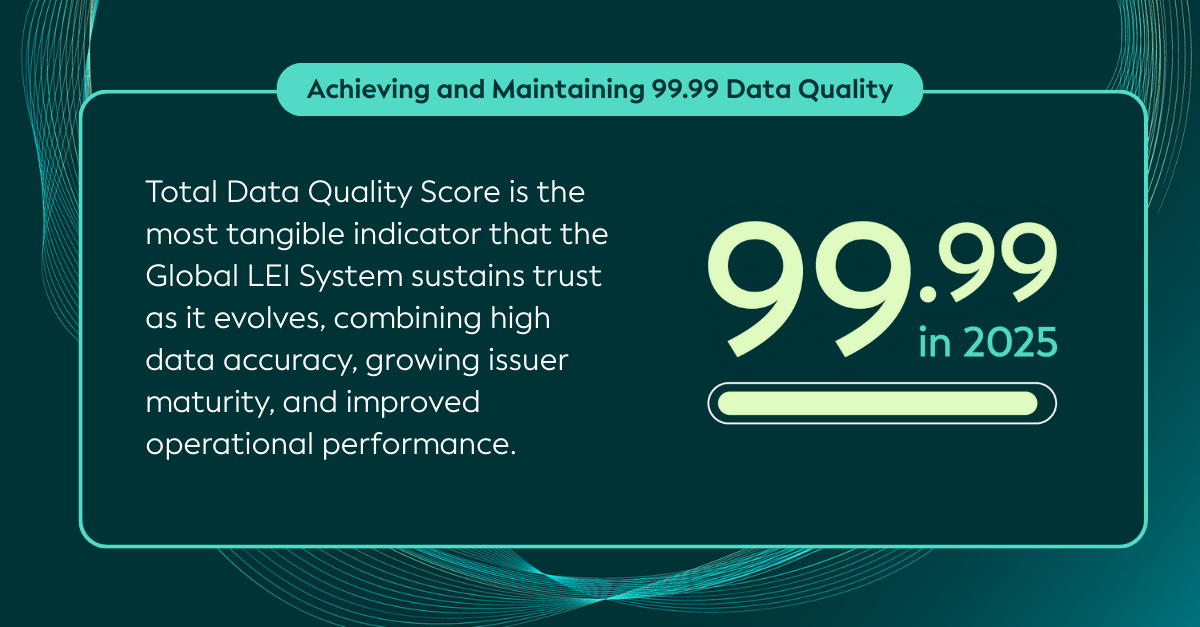
These efforts are translating into meaningful progress. At the end of each year, we reflect on how the Global LEI System continues to evolve. Over the past three years, the system has demonstrated sustained strengthening, with Total Data Quality Score improving from 99.96 in 2023 to 99.99 in 2024 and remaining stable at this level in 2025. At the same time, the distribution of achieved maturity levels across LEI issuers shows a clear and positive shift. The number of LEI issuers in the “Insufficient” category has reduced significantly, while the number of issuers meeting the “Required” and “Expected” levels has increased steadily. The group of LEI issuers reaching the “Excellent” level has remained consistently strong.
Operational performance has also continued to improve. In 2025, a total of 62,886 challenges were resolved. While this is slightly fewer than in the previous year, the average resolution time improved markedly, decreasing from 33 days to 14 days, reflecting increased efficiency and responsiveness across the system.
Recognizing the importance of collaboration
As we reflect on the undoubted progress and achievements of the past year, what stood out most was the spirit of collaboration. Bringing regulators, GLEIF, and LEI issuers into the same conversation creates the right space to challenge assumptions, align on priorities, and turn promising ideas into concrete progress. The exchange was genuinely helpful and productive, and it reaffirmed how much momentum we can build when we work together.
Looking ahead, sustained collaboration will help ensure that innovation proceeds responsibly and aligns with the principles of the Global LEI System – maintaining the LEI as a reliable global standard that evolves in step with technological progress and regulatory expectations. GLEIF looks forward to continuing this work with all partners and stakeholders to build an even more transparent, interoperable, and trusted future.
If you would like to comment on a blog post, please identify yourself with your first and last name. Your name will appear next to your comment. Email addresses will not be published. Please note that by accessing or contributing to the discussion board you agree to abide by the terms of the GLEIF Blogging Policy, so please read them carefully.
Zornitsa Manolova has been leading GLEIF’s Data Quality Management and Data Science team since April 2018, responsible for safeguarding and continuously improving data quality and governance across the Global LEI System by using advanced analytics to turn complex data into trusted infrastructure. With a long-standing focus on artificial intelligence and machine learning dating back to her university studies, Zornitsa has consistently applied cutting-edge analytical techniques to complex, real-world data challenges. Before joining GLEIF, she managed international forensic data analytics projects at PwC Forensics, supporting large-scale financial investigations and developing sophisticated approaches to entity resolution, anomaly detection, and data-driven insights.