Planned maintenance: Brief service interruptions may occur between 19 October and 4 November 2026.
News & Media
GLEIF Blog
Transforming Data into Opportunities: Metric in Motion – Understanding Corroboration
High-quality data is more than a benchmark – it is a strategic necessity for global trust, compliance and interoperability. In this blog, Zornitsa Manolova, Head of Data Quality Management and Data Science at GLEIF, explores how the Global LEI System verifies entity reference data against authoritative sources – and why this process is essential to maintaining trust at scale in a digital economy increasingly shaped by automation and AI.
Author: Zornitsa Manolova
Date: 2026-03-06
Views:
In an increasingly interconnected global economy, the ability for organizations to trust and use data effectively is the foundation for innovation, growth, and competitiveness.
A high-quality data ecosystem is a driver of change and innovation that enables organizations to identify and seize new opportunities, while low data quality can lead to inefficiencies and exposure to regulatory and reputational risks.
GLEIF is committed to optimizing the quality, reliability, and usability of LEI data. Since 2017, it has published dedicated monthly reports to transparently demonstrate the overall level of data quality achieved in the Global LEI System.
To aid broader industry understanding and awareness of GLEIF’s data quality initiatives, this new blog series explores key metrics included within the reports.
This month’s blog highlights why corroboration matters.
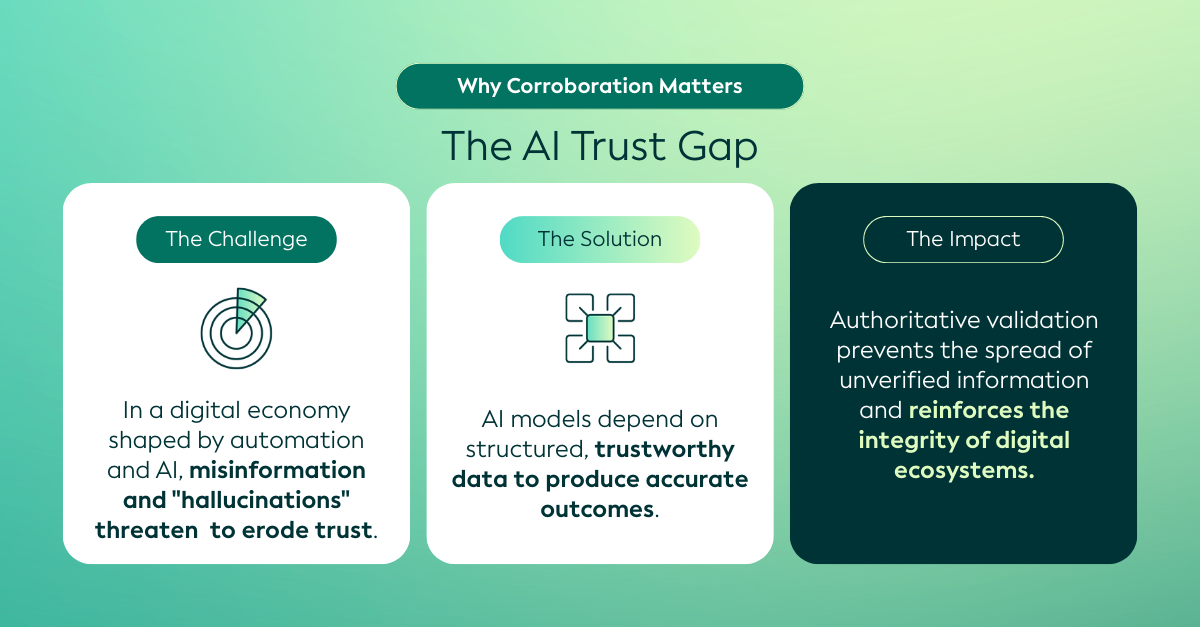
With AI and automation increasingly embedded across industries, the volume of data being processed and generated is growing rapidly – significantly increasing the complexity of data ecosystems. At the same time, misinformation and disinformation, deepfakes, and 'hallucinations' threaten to adversely impact outputs and erode trust.
This raises a critical question: how can trust in AI outputs be built and sustained? In a recent Pulse Poll, GLEIF asked the global data community to identify what factors most strongly influence decision-makers' trust. In response, authoritative data validation stood out as a leading consideration.
This comes as no surprise. As data is reused, redistributed, and embedded into automated systems and workflows, confidence in its provenance and accuracy moves from a technical issue to a foundational governance requirement. Consequently, the key role of corroboration in ensuring that Legal Entity Identifier (LEI) data is reliable, traceable, and transparent is being reinforced.
Why Corroboration Matters More than Ever in the Age of AI
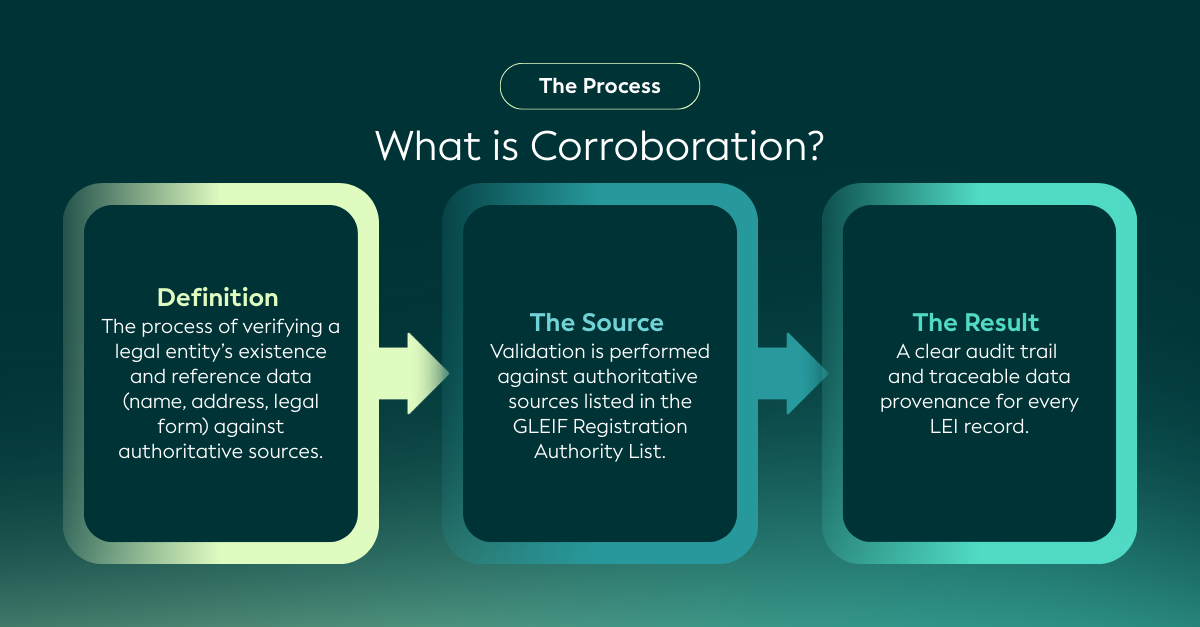
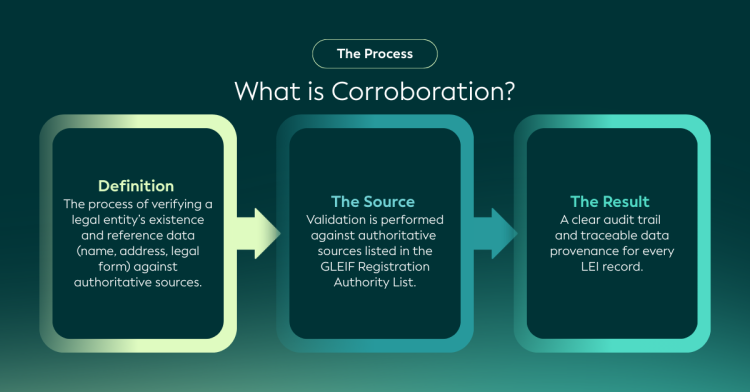
In simple terms, corroboration is the process of verifying the existence of a legal entity and its reference data – such as name, address, legal form, and corporate structures – against authoritative sources. These trusted sources are listed in the GLEIF Registration Authority List. LEI issuers validate the information provided by the legal entity by comparing it against the publicly available authoritative data.
As AI models and agents depend on structured, trustworthy data to produce accurate outcomes, this authoritative validation is critical to preventing the propagation of inaccurate or unverified information within automated systems. By clearly demonstrating how and where information has been validated, the Global LEI System provides a clear audit trail and traceable data provenance. This reduces the risk of misinformation, supports model reliability, and reinforces the integrity of digital ecosystems.
Understanding Corroboration
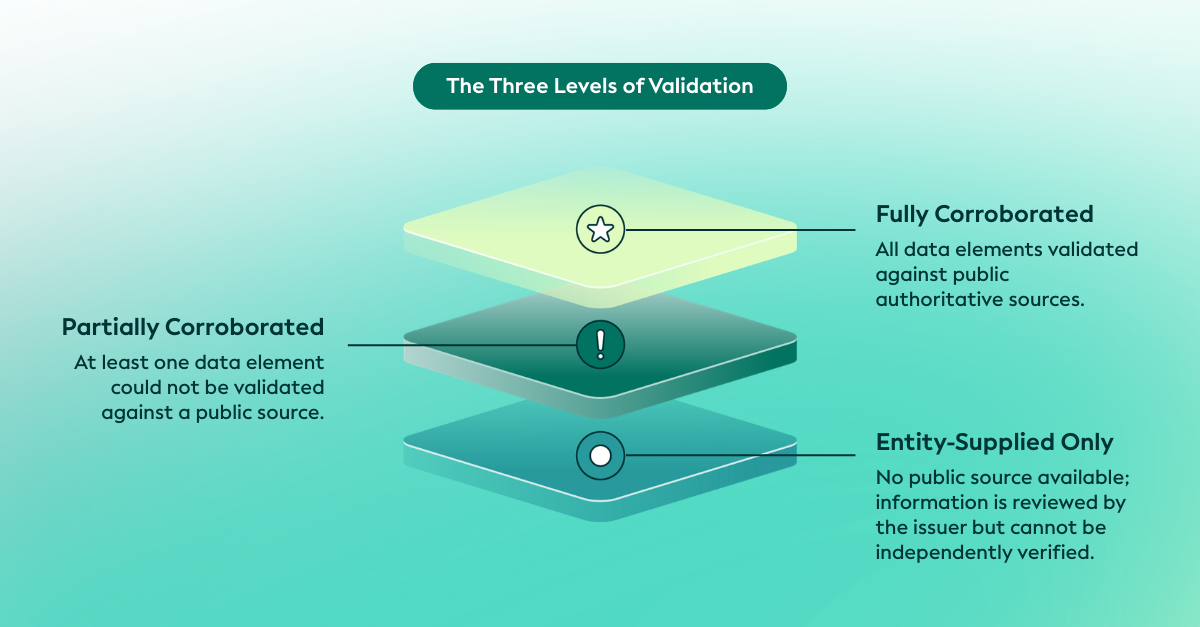
The Global LEI System uses three levels to indicate the extent to which data has been corroborated:
FULLY_CORROBORATED: All reference data elements have been validated against public authoritative sources.
PARTIALLY_CORROBORATED: At least one data element could not be validated against a public authoritative source.
ENTITY_SUPPLIED_ONLY: No public authoritative source is available. The information provided directly by the entity has been reviewed by the LEI issuer, but it cannot be independently verified against public data.
To ensure validation is performed consistently and transparently, GLEIF maintains an official list of Registration Authorities, each assigned a unique Registration Authority (RA) ID. This list includes business registries, financial supervisors, and other recognized authoritative sources worldwide that LEI issuers rely on to validate entity information.
The corresponding Registration Authority ID and Validation Authority ID, together with the entity’s registration identifier, are included in each LEI record. This creates transparency by allowing any data user to see exactly which source was used for validation.
Tracking Progress Across the Global LEI System
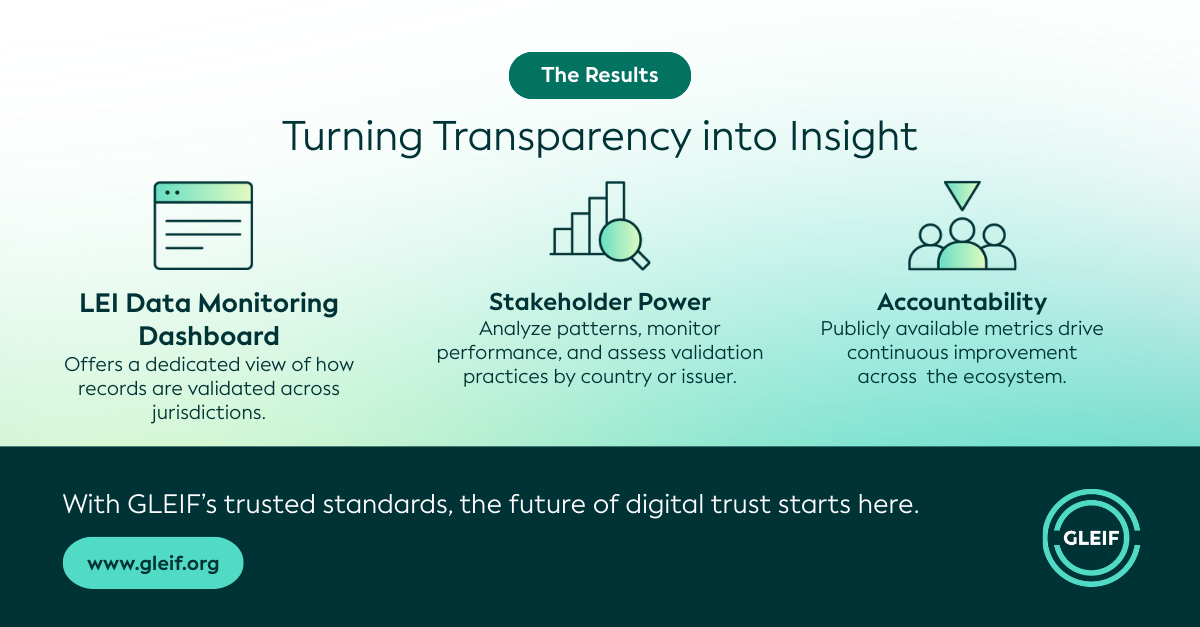
GLEIF’s LEI Data Monitoring Dashboard offers a dedicated view of how LEI records are validated across jurisdictions. It provides insight into the level of corroboration applied and breaks down validation metrics by LEI issuer and country. This transparency enables stakeholders to analyse patterns, monitor data quality performance, and assess validation practices across the Global LEI System. By making these metrics publicly available, GLEIF strengthens accountability and continuous improvement across the ecosystem.
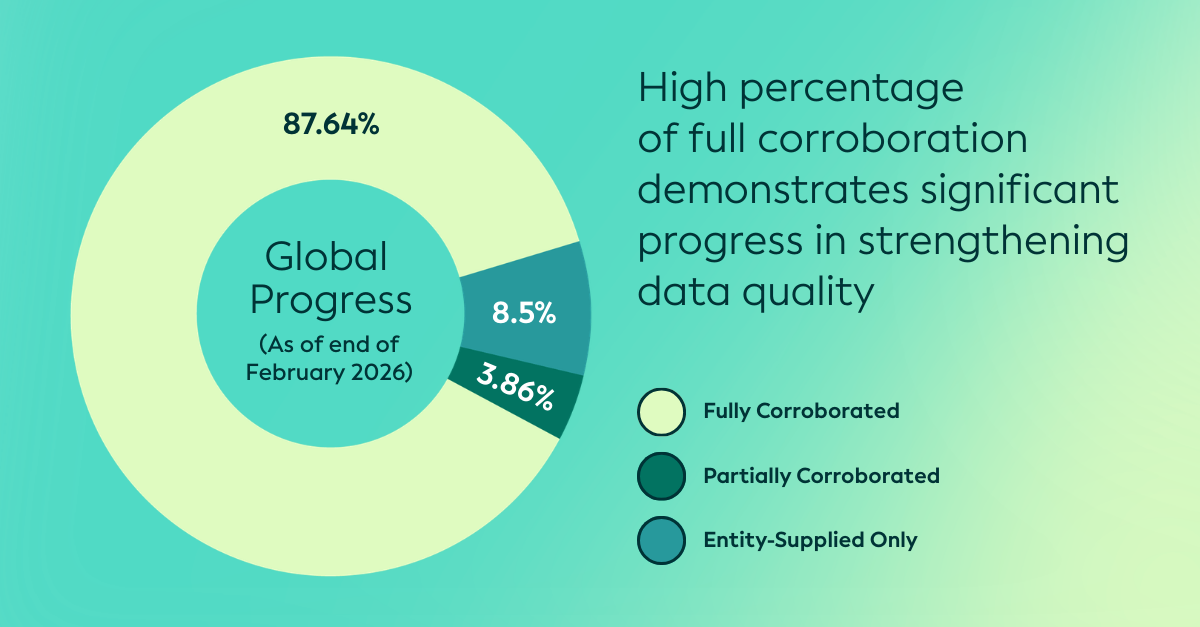
As of the end of February 2026, 87.64% of LEI records are fully corroborated, demonstrating a strong level of validation across the system. The remaining records consist of 8.5% classified as entity-supplied only, and 3.86% as partially corroborated. Partially corroborated records typically relate to specific data elements that are not collected or publicly disclosed by the relevant local authority. Entity-supplied only records usually concern entities that are not required to register with a public authority, or where certain information cannot be made publicly available due to privacy or legal constraints.
Overall, the high percentage of fully corroborated records and continuous monitoring via the LEI Data Monitoring Dashboard demonstrate significant progress in strengthening data quality.
Promoting Global Trust Through Corroboration
In a digital economy increasingly shaped by automation and AI, reliable and traceable entity data is essential. By systematically validating entity reference data against authoritative sources and clearly disclosing the level of validation applied, corroboration is a foundational mechanism that ensures transparency and data integrity across the Global LEI System. Ultimately, this transforms raw data into trusted data, and trusted data into opportunity.
If you would like to comment on a blog post, please identify yourself with your first and last name. Your name will appear next to your comment. Email addresses will not be published. Please note that by accessing or contributing to the discussion board you agree to abide by the terms of the GLEIF Blogging Policy, so please read them carefully.
Zornitsa Manolova has been leading GLEIF’s Data Quality Management and Data Science team since April 2018, responsible for safeguarding and continuously improving data quality and governance across the Global LEI System by using advanced analytics to turn complex data into trusted infrastructure. With a long-standing focus on artificial intelligence and machine learning dating back to her university studies, Zornitsa has consistently applied cutting-edge analytical techniques to complex, real-world data challenges. Before joining GLEIF, she managed international forensic data analytics projects at PwC Forensics, supporting large-scale financial investigations and developing sophisticated approaches to entity resolution, anomaly detection, and data-driven insights.