Planned maintenance: Brief service interruptions may occur between 19 October and 4 November 2026.
News & Media
GLEIF Blog
Transforming Data into Opportunities: Metric in Motion – GLEIF AI
High-quality data is more than a benchmark – it is a strategic necessity for global trust, compliance, and interoperability. In this blog, Zornitsa Manolova, Head of Data Quality Management and Data Science at GLEIF, explores how the new GLEIF AI Search makes it easier to access, understand, and use trusted organizational identity data.
Author: Zornitsa Manolova
Date: 2026-05-08
Views:
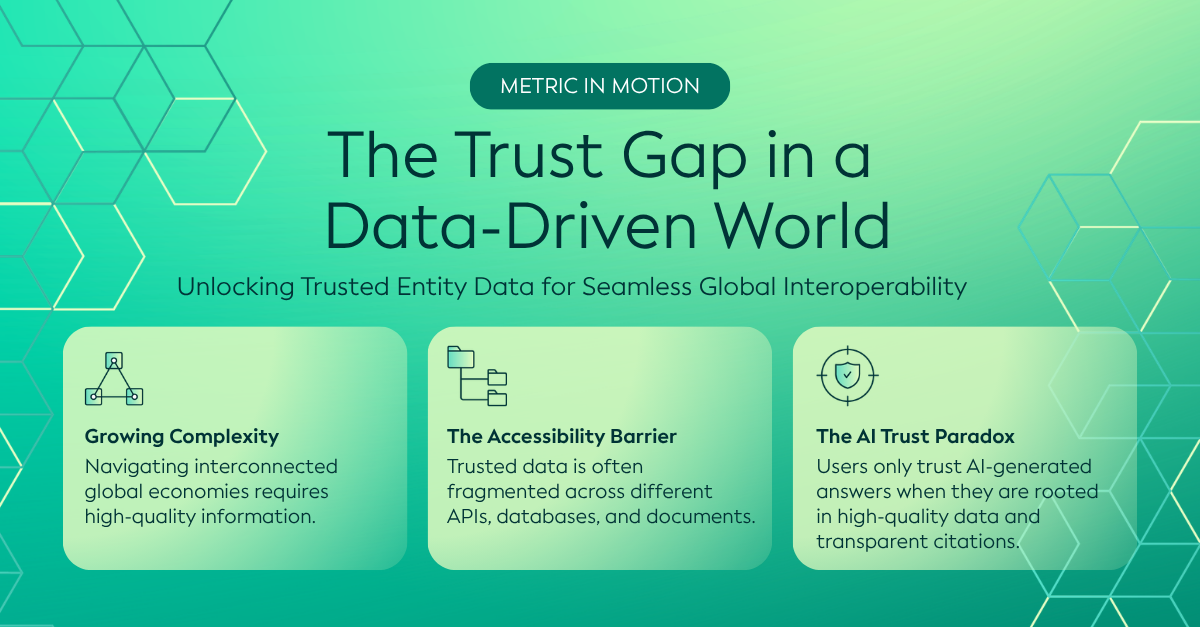
The ability to access and trust high-quality organizational data enables better decision-making across the global economy. This is why GLEIF publishes a wide range of trusted information, from the Global LEI Index, statistics, and reports to governance policies, news, and more.
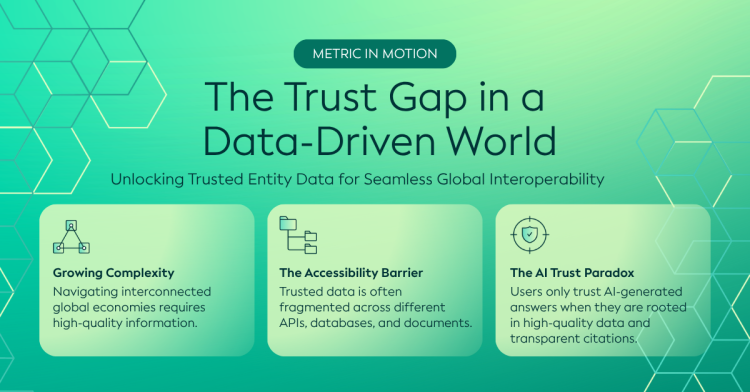
However, because information spans APIs, databases, documents, and web pages, navigating these different entry points can be difficult and time-consuming for some users seeking a quick, reliable answer.
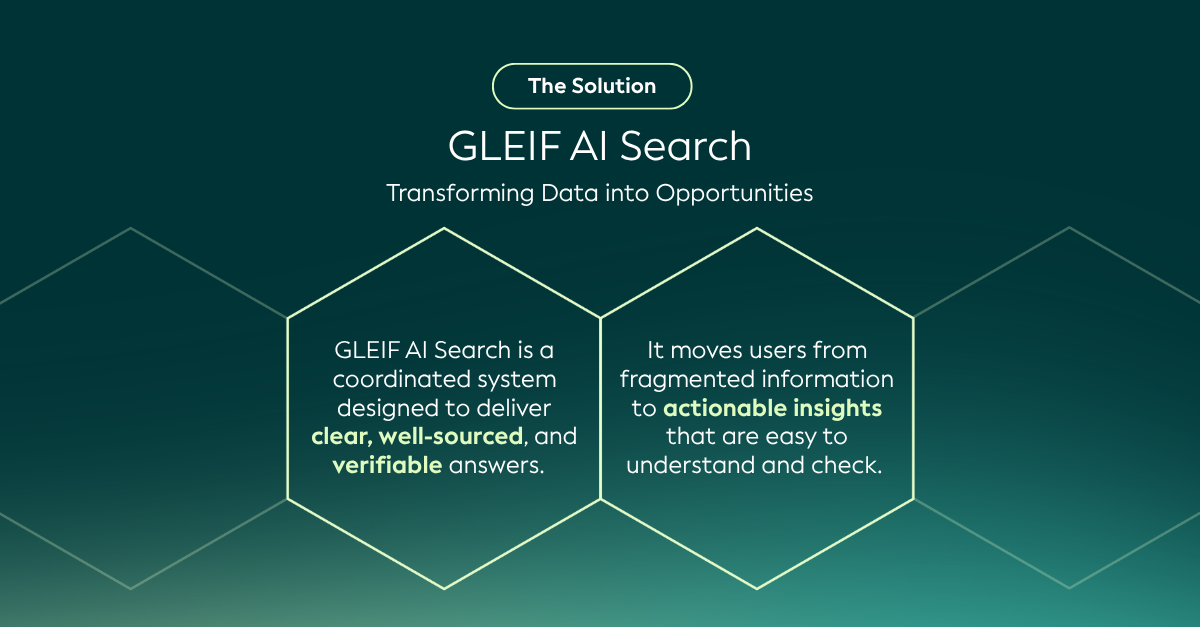
This challenge – and the opportunity to make GLEIF’s trusted information more accessible to external AI solutions – motivated the development of GLEIF AI Search. The new capability transforms the way users interact with complex, distributed data by combining conversational interfaces with a structured retrieval pipeline to streamline discovery and improve accessibility.
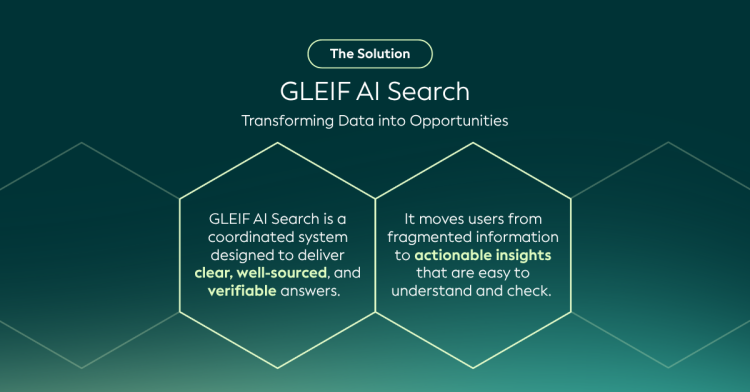
It also places trust at the center, delivering clear, well-sourced answers that users can rely on. Insights from a recent poll show that users trust AI-generated answers most when they are based on high-quality underlying data, supported by transparent source citation, and include clear explanations. This reinforces the importance of GLEIF’s role in providing reliable, well-structured data that can support trustworthy AI-enabled discovery.
This echoes a theme explored in GLEIF’s Metric in Motion blog on corroboration. In an AI-enabled digital economy, trust depends not only on access to data, but also on knowing where that data comes from, how it has been validated, and whether it can be traced back to authoritative references. GLEIF AI Search applies this principle to information discovery, helping users move from fragmented information to answers that are easier to understand, verify, and use.
How it works
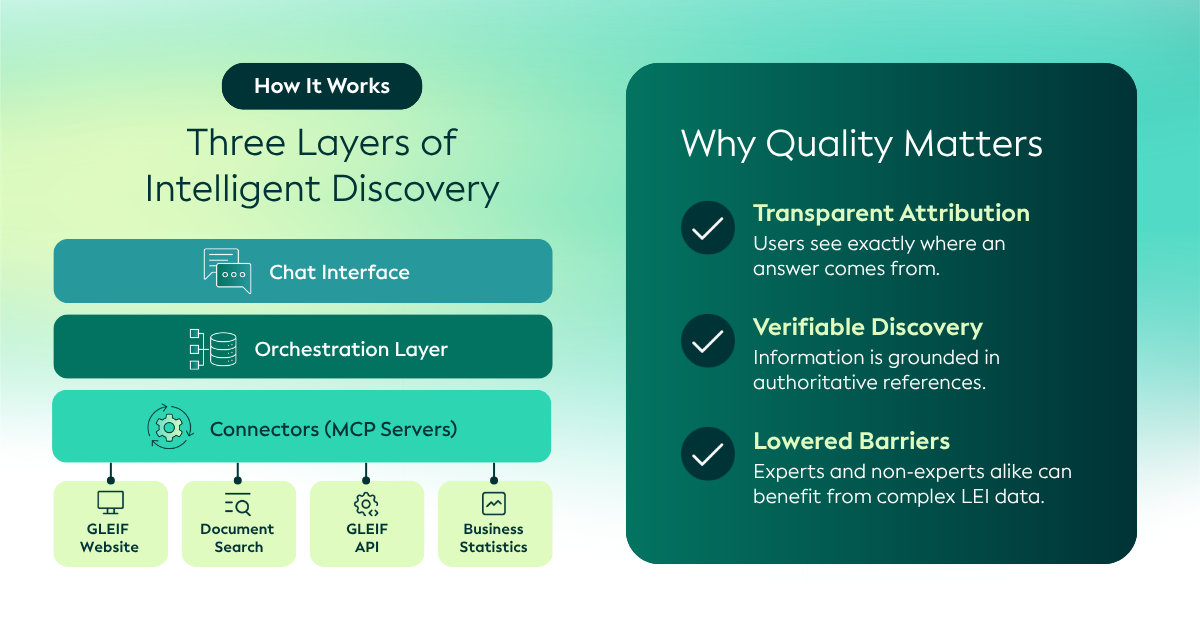
GLEIF AI Search is a coordinated system of three core layers working seamlessly together:
Chat Interface:
The chat interface is the user-facing layer of GLEIF AI Search. It provides a clean, intuitive, and conversational way for users to engage naturally with the system and choose from different assistant modes: Smart, Website & Docs, News & Updates, Data & Statistics, and LEI Records. Each mode is tailored to a specific type of query or task, ensuring that interactions feel both guided and adaptable, depending on the user’s intent.
Orchestration Layer:
Behind the user interface is the orchestration layer, which processes each user query. It activates the selected assistant mode, routes the request to a large language model, and coordinates the necessary tools to retrieve and verify relevant information before providing a response.
Crucially, this layer does not operate in isolation. It dynamically helps ensure that answers are not produced by the model alone but are informed by relevant data, documents, and web content from various connectors. This coordination transforms model output into context-aware, reliable answers.
Connectors (MCP Servers):
The connectors form the bridge between the orchestration layer and the underlying data and content sources. Implemented as MCP (Model Context Protocol) servers, these connectors enable the system to access and interact with external sources in a structured, reusable way. They ensure that the GLEIF AI Search is not limited to static knowledge and can use current, relevant information from GLEIF data, APIs, documents, and web content. The connectors currently available are:
Web Search and Fetch: Enables the AI to search, retrieve, and process content from the GLEIF website (gleif.org). This supports questions about GLEIF’s activities, news, governance, and general information.
Document Search: Links to a vector-based search system built over a collection of official GLEIF documents, such as policy papers and governance frameworks. When a question pertains to content in these documents, the AI can search them and cite relevant passages.
GLEIF API Connector: Integrates directly with the official public GLEIF API, providing real-time access to the Global LEI Index. This allows the AI to look up individual entities by their LEI, search for entities by name, and retrieve detailed registration information and relationship data.
LEI Statistics Connector: Links to aggregated statistics related to the Global LEI System. It enables the system to query structured analytical data such as the number of active LEIs by country, issuance trends over time, growth rates, and distributions across entity types or jurisdictions.
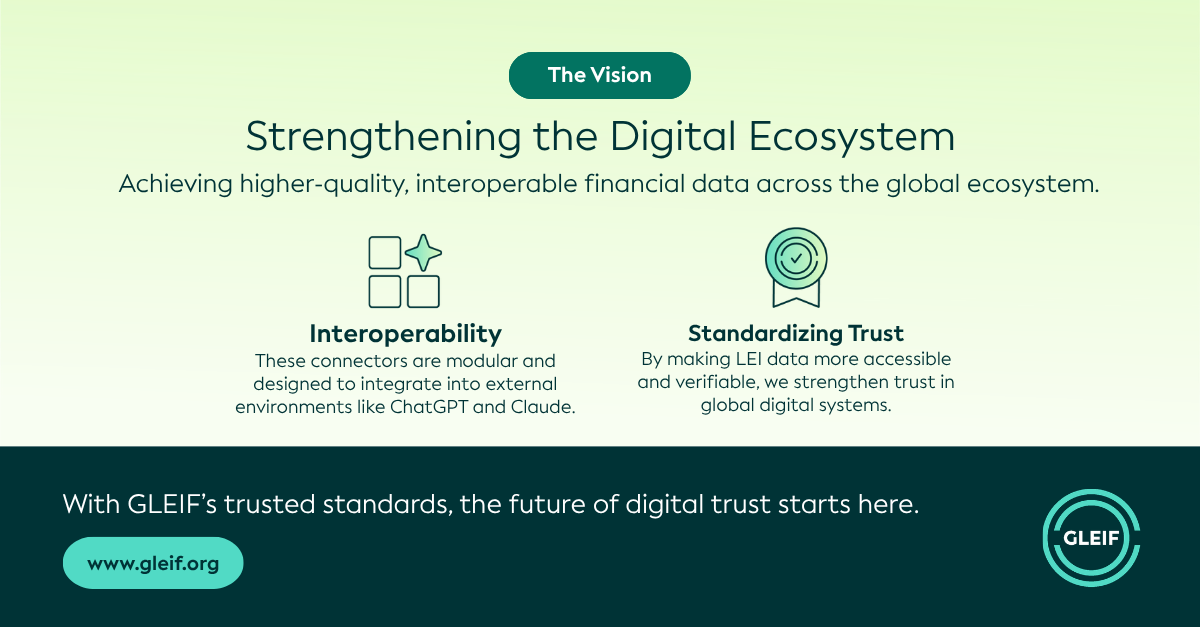
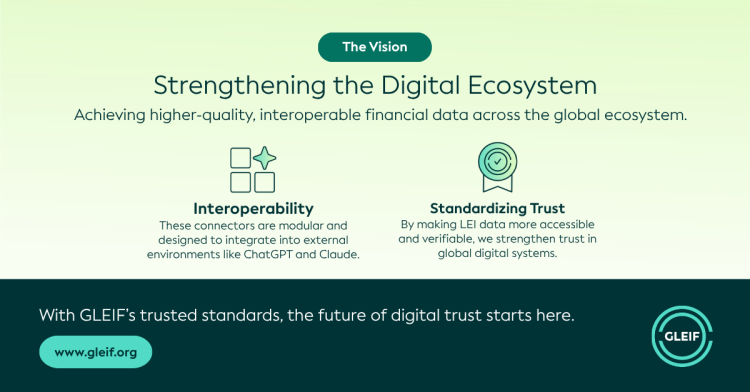
Importantly, these MCP servers are designed to be modular, reusable, and interoperable. They can also be integrated into external AI environments such as ChatGPT, Claude, and others. GLEIF has already defined skills based on these capabilities and made them available on the GLEIF webpage. Looking ahead, GLEIF plans to expand the number of available connectors by adding more MCP servers, further extending the system’s capabilities, and addressing a wider range of user needs.
The benefits of GLEIF AI
GLEIF AI Search and its related connectors are designed to make LEI and GLEIF information easier to access, understand, and use – delivering significant benefits to global data users:
Improved access to trusted data: Helps users explore LEI data, statistics, reports, governance documents, and other GLEIF content through a conversational interface, instead of navigating multiple systems separately.
Comprehensive insights: Retrieves and combines information from APIs, databases, documents, and websites to provide more complete and well-rounded answers.
Transparent and verifiable responses: Supports clear source attribution and explanation, helping users understand where an answer comes from and how far it can be relied upon.
Clearer summaries: Converts complex or lengthy information into concise, human-readable responses.
Support for decision-making: Provides reliable and well-sourced answers that can help users find information more efficiently and act with greater confidence.
Broader usability: Lowers the barrier to entry, enabling both experts and non-experts to interact with and benefit from LEI data.
Harnessing the potential of AI search
As AI-powered search continues to evolve, its true value will be defined by more than speed or convenience. What matters is the ability to consistently deliver answers grounded in reliable, transparently sourced data and contextually relevant.
GLEIF AI Search illustrates how combining trusted data with intelligent retrieval mechanisms can realize these requirements, making complex information easier to access and use. By connecting user questions to official data, documents, and web content, it turns distributed information into answers that are easier to understand, verify, and act on – reinforcing reliability and data integrity as fundamental pillars of digital innovation.
Looking ahead, this approach can support broader use of GLEIF data across different AI environments. By making information more accessible, transparent, and verifiable, GLEIF AI Search can help strengthen trust in digital systems and support more informed decision-making.
If you would like to comment on a blog post, please identify yourself with your first and last name. Your name will appear next to your comment. Email addresses will not be published. Please note that by accessing or contributing to the discussion board you agree to abide by the terms of the GLEIF Blogging Policy, so please read them carefully.
Zornitsa Manolova has been leading GLEIF’s Data Quality Management and Data Science team since April 2018, responsible for safeguarding and continuously improving data quality and governance across the Global LEI System by using advanced analytics to turn complex data into trusted infrastructure. With a long-standing focus on artificial intelligence and machine learning dating back to her university studies, Zornitsa has consistently applied cutting-edge analytical techniques to complex, real-world data challenges. Before joining GLEIF, she managed international forensic data analytics projects at PwC Forensics, supporting large-scale financial investigations and developing sophisticated approaches to entity resolution, anomaly detection, and data-driven insights.