The LEI in Numbers: Global Transparency and Digitalization Push Drives LEI Adoption in 2025
As the digitalization of the global economy accelerates, the convergence of regulatory and market-led initiatives promoting LEI adoption demonstrates the urgent need for greater openness, accountability, and interoperability across borders and ecosystems.
Author: Alexandre Kech
Date: 2026-01-26
Views:
The Global LEI Foundation (GLEIF) is proud of its ongoing transparency initiatives, including its open approach to providing unrestricted access to the latest LEI data from around the world with the Quarterly LEI System Business Reports, which are made publicly available free of charge. Through this ‘LEI in Numbers’ blog series, GLEIF aims to highlight key data from the latest report, explaining trends and profiling successes from the global LEI rollout.
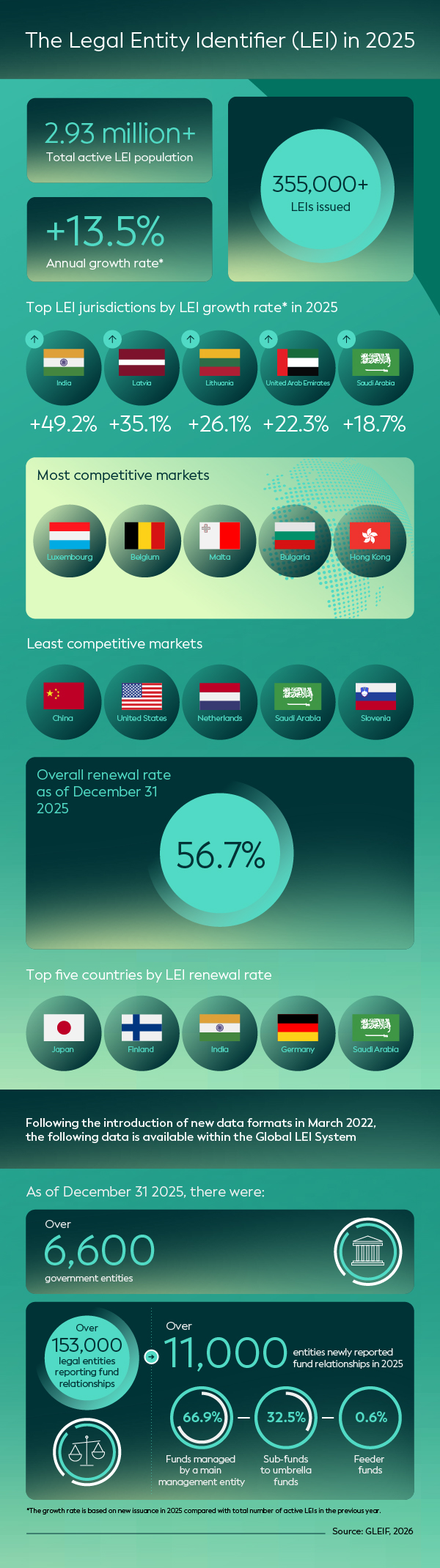
The Global LEI System saw sustained expansion in 2025. More than 355,000 new LEIs were issued, increasing the total active LEI population to over 2.93 million. This represents a strong annual growth rate of 13.5%, up from 11.5% in 2024.
India once again saw the highest LEI growth rate in 2025 (49.2%), retaining its position as the second-largest jurisdiction by active LEI population. This followed the phase-wise introduction of the LEI for all large corporate borrowers of banks, marking the continuation of a proactive regulatory agenda that has embedded the LEI within the Indian economy to promote greater trust and transparency.
The application of the European Union’s Digital Operational Resilience Act (DORA) – which aims to enhance the operational resilience of financial entities by improving their ability to manage ICT-related risks – also had a significant impact on LEI adoption throughout 2025 and signaled a major implementation outside of capital markets. DORA requires financial institutions to identify all EU-registered ICT service providers using an active LEI or European Unique Identifier (EUID), with the LEI mandated as the sole identifier for organizations registered outside the EU. This drove particularly strong growth in Latvia (35.1%) and Lithuania (26.1%).
Elsewhere, the market activities of local LEI issuers promoted impressive LEI adoption in the United Arab Emirates (22.3%) and Saudi Arabia (18.7%). These jurisdictions ranked fourth and fifth for LEI growth in 2025, highlighting their emergence as major economic hubs increasingly connected to global marketplaces.
Looking ahead to 2026
As we reflect on the past year, the convergence of regulatory initiatives demanding increased transparency and the growing voluntary uptake to support digitalization across the global economy underscores an urgent need for greater openness, accountability, and interoperability across borders and ecosystems.
In response, GLEIF remains committed to expanding the use of the LEI and the verifiable LEI (vLEI) to accelerate economic growth by hardwiring verifiable organizational identity, and therefore trust, into every business relationship.
Key priorities include:
Enabling faster, cheaper, and safer cross-border payments, following the landmark inclusion of the LEI in the Financial Action Task Force (FATF) Recommendation 16 on Payment Transparency.
Supporting the digitalization of global value chains to promote more efficient, trusted trade.
Fostering a responsible, compliant, and innovative digital asset market aligned with global standards.
This will be underpinned by ongoing initiatives to increase the reach and coverage of the Global LEI System worldwide, a commitment to collaboration to drive organizational identity innovation across emerging use-cases and sectors, and an enduring focus on data quality.
A spotlight on Q4 2025
89,000 LEIs were issued in Q4 2025, up from 81,000 in the previous quarter. This represents a quarterly growth rate of 3.1%. India (8%) had the highest growth, followed by Lithuania (6%), the United Arab Emirates (5.7%), Latvia (5.5%), and France (4.6%).
Notably, this was the first time France has been among the top five growth jurisdictions. It is home to three Global Systemically Important Banks (G-SIBs) – the joint most of any jurisdiction in Europe – and the LEI is playing an important role in enabling the continuous, consistent, and unambiguous identification of entities across borders to support DORA compliance. France’s position as a key payments corridor also saw increased uptake of the LEI to support more effective Verification of Payee in line with the EU’s Instant Payments Regulation (IPR).
Driving LEI renewals
The overall LEI renewal rate declined slightly to 56.7% in Q4 2025, from 57.1% in the previous quarter. In the EU, the renewal rate reduced to 61.2%. The ongoing uptick in renewals in non-EU jurisdictions continued, however, increasing to 49.5%. The jurisdictions with the highest renewal rates were Japan (90%), Finland (83.1%), India (79.3%), Germany (72.9%), and Saudi Arabia (72.2%).
Driving continued improvements in LEI renewals is an ongoing priority for the Regulatory Oversight Committee (ROC) and GLEIF. For instance, the Policy Conformity Flag was launched to make it clear to global data users whether an LEI record is up to date and complete with relationship reporting. A dedicated task force of ROC and GLEIF representatives is also analyzing and exploring further strategic opportunities to encourage renewals and promote current, complete data reporting.
The ongoing expansion of the Validation Agent network, which allows financial institutions and other supervised organizations involved in legal entity identity verification and validation to obtain and maintain LEIs for their clients in cooperation with accredited LEI issuers, stands to play an important role in this regard. At the end of 2025, there were 23 Validation Agents spanning Africa, Australasia, China, Europe, India, the Middle East, and North America.
Regarding the ROC policies on LEI data formats, over 6,600 entities were identified as government entities (up from 6,500 in Q3 2025), and 81 were identified as international organizations. More than 153,000 legal entities reported fund relationship structures, an increase of nearly 2,000 on the previous quarter.
For the full report, which includes further detail on the status of LEI issuance and growth potential, the level of competition between LEI issuing organizations in the Global LEI System, and Level 1 and 2 reference data, please visit the Global LEI System Business Reports page.
If you are interested in reviewing the latest daily LEI data, our Global LEI System Statistics Dashboard contains daily statistics on the total and active number of LEIs issued. This feature now enables any user to review historical data by geography, increasing transparency on the overall progress of the LEI.
For further details or to access historical data, please visit the Global LEI System Business Report Archive. We look forward to sharing our progress each quarter as we continue to drive LEI adoption in 2026.
If you would like to comment on a blog post, please identify yourself with your first and last name. Your name will appear next to your comment. Email addresses will not be published. Please note that by accessing or contributing to the discussion board you agree to abide by the terms of the GLEIF Blogging Policy, so please read them carefully.
Alexandre Kech is the CEO of the Global Legal Entity Identifier Foundation (GLEIF).
Prior to joining GLEIF, Alexandre Kech was Head of Digital Securities at the SIX Digital Exchange. As a member of the Executive Board, Alex had full executive responsibility for the Digital Securities business vertical, including sales and relationship management, product development, business design, and ecosystem expansion.
Over the past 25 years, Alex has constructed a unique career combining finance at BNY Mellon, payments/securities infrastructure and standards at SWIFT, and blockchain and digital assets at Onchain Custodian (ONC) and, most recently, Citi Ventures. As co-founder and CEO of ONC, Alex led the Singapore and Shanghai-based team that built custody and prime brokerage services for crypto and other digital assets from scratch. As Blockchain & Digital Asset director at Citi Ventures, he built a team to engage the European ecosystem on emerging use cases for blockchain technologies and digital assets.
Alex is also involved in industry and standardization initiatives. As the convenor of the ISO TC 68 / SC8 / WG3, which produced the ISO 24165 Digital Token Identifier (DTI), he is a member of the DTI Foundation Product Advisory Committee. He also recently served as co-chair of the Global Digital Finance (gdf.io) custody working group.
Alex earned a bachelor’s degree in translation and an Executive MBA from the Quantic School of Business and Technology while building Onchain Custodian, putting theory into practice in real-time.