Planned maintenance: Brief service interruptions may occur between 19 October and 4 November 2026.
News & Media
GLEIF Blog
The Missing Layer: How the Global LEI System is becoming a Global Digital Public Infrastructure for Business Identity
Governments are building Digital Public Infrastructure yet, until now, the layer that lets organizations verify one another across borders has been missing. In this blog, Alexandre Kech, CEO, GLEIF, explores how the Global LEI System is addressing this critical need by evolving into a global DPI for business identity.
Author: Alexandre Kech
Date: 2026-09-09
Views:
Around the world, governments are building the digital foundations of modern economies: payment rails for fast, secure money movement; digital identity schemes that let citizens prove who they are; and data platforms that enable the digital integration of public services.
Collectively, this "plumbing" is known as Digital Public Infrastructure (DPI): essential digital systems that no single company owns, yet everyone relies on, and that enable digitized economies to function. Definitions vary; the most concise comes from the World Bank, which describes DPI as "…shared, foundational digital building blocks designed for the public benefit."
So far, most national DPI efforts have concentrated on identifying and serving people. Critically, however, every economy also needs to identify and serve organizations, which is far harder. Currently, when a company in one country wants to pay, contract with, or onboard a company in another, it hits a wall of friction. Business registration data sits in national silos, in different languages and formats. No single, trustworthy way exists to confirm that a counterparty is real, legitimate, and genuinely represented by the people acting on its behalf.
The hidden cost of friction
The "friction wall" is no minor inconvenience. It slows trade, raises the cost of cross-border payments, creates openings for fraud and money laundering, and shuts out smaller organizations that cannot easily prove their legitimacy. As more commerce moves online, the gap grows, and the need becomes more urgent: only verifiable organizations can participate fully in global markets. Most businesses won't deal with a counterparty they cannot verify.
A public good, first proven in capital markets
Happily, the solution to this problem already exists and has worked at scale for more than a decade.
The Global LEI System was created after the 2008 financial crisis, when regulators found they could not reliably answer a simple question: who was connected to whom in the global financial system? The LEI is a unique, globally standardized code that connects to verified reference data to unambiguously identify a legal entity. It renews every year and is freely available to anyone, anywhere in the world.
Its track record is substantial: regulators worldwide have written the use of the LEI into their mandates and, thanks to an active LEI population of over three million entities, it has brought unprecedented transparency to capital markets and greatly strengthened the global fight against financial crime.
Crucially, the LEI was never designed to be owned by any one government or company. From the outset, its originators - the G20, the Financial Stability Board, and the Regulatory Oversight Committee - intended it as a "broad public good": open, standardized, and freely accessible to all. GLEIF, a supra-national, not-for-profit foundation free of geopolitical, commercial, and technological influence, maintains the Global LEI System that makes this possible.
The Global LEI System's value as a "broad public good" is now being sought far beyond capital markets. Wherever organizations must establish trust quickly, at a distance, and across borders, the LEI is emerging as the natural foundation. The EU's Digital Operational Resilience Act (DORA) marked the LEI's first major use outside capital markets, and regulatory support is now building across payments, supply chains, and digital assets. In this way, the Global LEI System has remained true to its roots as a "public good" and has grown into something larger than a financial compliance tool: an international organizational identity infrastructure and a global Digital Public Infrastructure for business identity.
The identity layer that connects DPIs together
This is where the Global LEI System matters most to anyone building DPI today. National and regional DPIs are, by design, built for their own jurisdiction, which is both their strength and their limit. A business registry in one country does not automatically speak to a registry, payment system, or identity scheme in another; today's verified organizational identity tends to stop at the border.
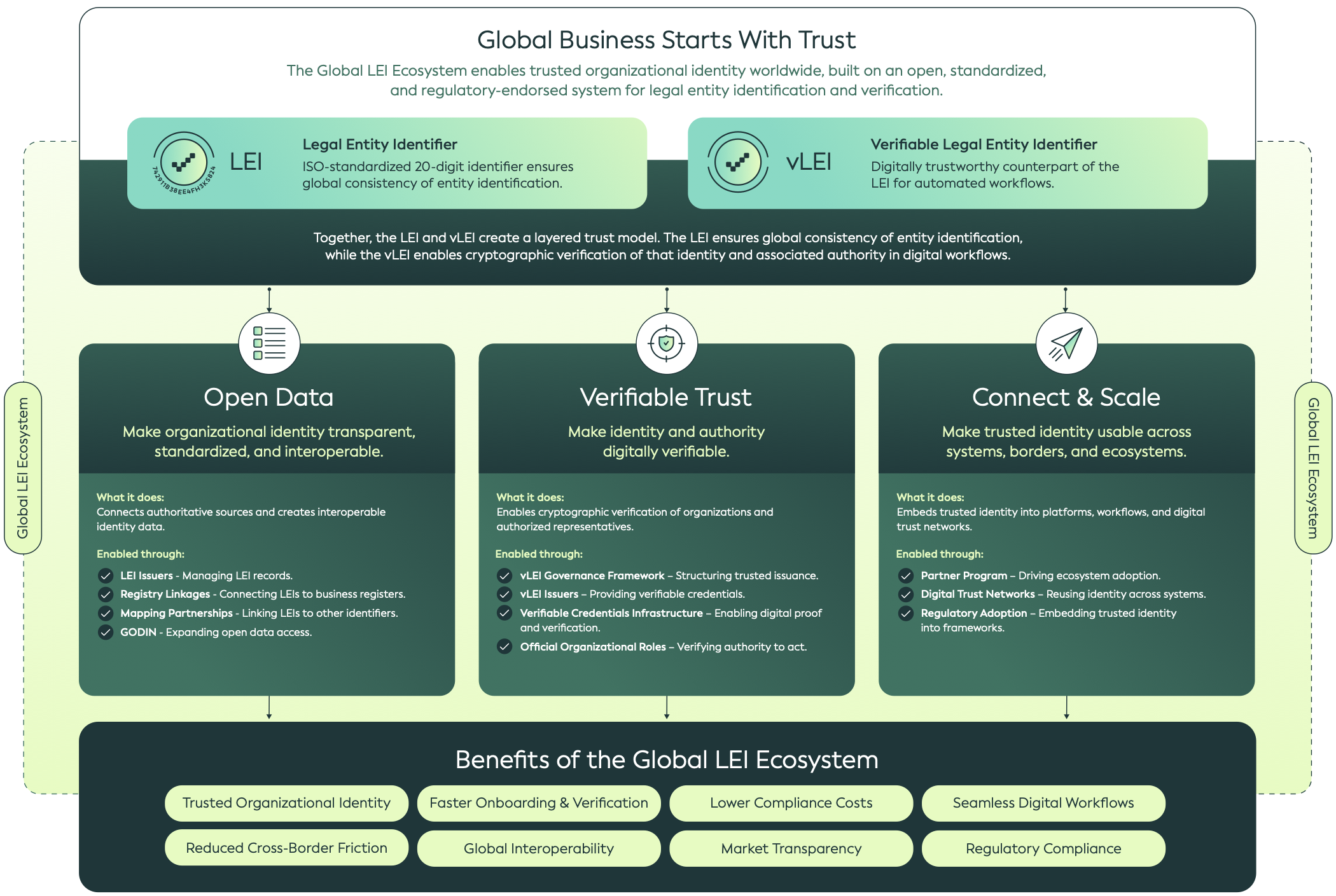
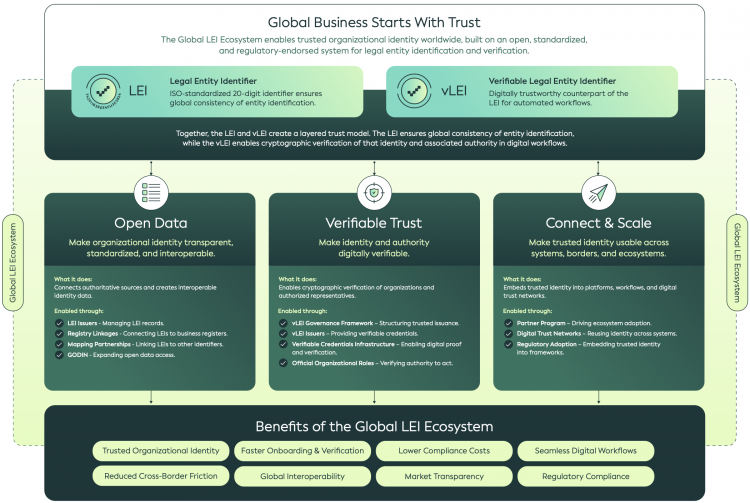
The Global LEI System closes that gap. It provides standardized organizational identifiers that connect into any national or regional DPI, so each gains an internationally recognized, freely available way to discover and verify businesses in every connected jurisdiction. In effect, it is an interoperability layer: the connective tissue between DPI ecosystems that would otherwise stay isolated, and the organizational identity layer most DPI initiatives are missing.
Rather than build it alone, DPI creators can plug into a system that is already governed, already global, and already trusted by regulators. Alongside the LEI, its digital counterpart the verifiable LEI (vLEI) extends the same trust to automated, machine-to-machine interactions, preparing organizational identity for an increasingly AI-enabled world.
Delivering across the three pillars of DPI
If the World Bank offers the cleanest definition, the Gates Foundation - another prominent voice in the field - offers a useful lens for seeing DPI in practice, describing it as three foundational systems: digital identity, digital payments, and data exchange. These are usually discussed in terms of individuals. When applied to organizations, they are exactly where the Global LEI System delivers, and it already does so at scale:
Digital identity: The LEI provides a single organizational identifier that connects to local registries and enables consistent recognition of a business across every jurisdiction. That identity is now trusted well beyond finance - adoption spans public and private sectors, and it is increasingly written into regulation such as DORA.
Digital payments: Verified identity is what tells a payment system that money is reaching the right business. The LEI has broad support across the payments community, including the Financial Action Task Force (FATF), the EU's Instant Payments Regulation, the Bank for International Settlements, and SWIFT. FATF's updated Recommendation 16 references the LEI to strengthen the fight against money laundering and terrorist financing in domestic and cross-border transactions. This is precisely the level of assurance a national payment rail needs when it connects to one abroad.
Data exchange: The Global LEI System does what a purely national system cannot: it bridges different identification schemes. Through its mapping program, the LEI is certified-linked to other widely used identification systems, so organizations can reconcile records across systems without rebuilding them. Its linking program connects the LEI to local registration data, and its data-quality work steadily raises the accuracy and availability of business information for statistical, analytical, and regulatory use. For a DPI creator, this means connecting once, rather than negotiating a separate integration with every counterparty system.
Taken together, these three separate claims become one: the Global LEI System supplies the verified organizational layer each pillar of DPI depends on, and makes it interoperable across borders.
An invitation to build on shared foundations
DPI is most powerful when its building blocks connect: a payment system is more valuable when it can identify who is being paid, and an identity scheme when it recognizes identities beyond its own borders. Interoperability is not a feature added at the end; it is the whole point. For the architects of DPI - policymakers, regulators, and institutions designing the digital foundations of their economies - the Global LEI System offers a ready-made solution, open and free to build on, that turns national infrastructure into part of a connected global whole.
This is the first in a series of blogs exploring what that connection makes possible. In pieces that follow, we will examine specific use cases, from cross-border payments to supply chains and beyond, to explore how a shared foundation of verified business identity can help money, goods, and services move around the world more freely, securely, and cheaply than ever before.
If you would like to comment on a blog post, please identify yourself with your first and last name. Your name will appear next to your comment. Email addresses will not be published. Please note that by accessing or contributing to the discussion board you agree to abide by the terms of the GLEIF Blogging Policy, so please read them carefully.
Alexandre Kech is the CEO of the Global Legal Entity Identifier Foundation (GLEIF).
Prior to joining GLEIF, Alexandre Kech was Head of Digital Securities at the SIX Digital Exchange. As a member of the Executive Board, Alex had full executive responsibility for the Digital Securities business vertical, including sales and relationship management, product development, business design, and ecosystem expansion.
Over the past 25 years, Alex has constructed a unique career combining finance at BNY Mellon, payments/securities infrastructure and standards at SWIFT, and blockchain and digital assets at Onchain Custodian (ONC) and, most recently, Citi Ventures. As co-founder and CEO of ONC, Alex led the Singapore and Shanghai-based team that built custody and prime brokerage services for crypto and other digital assets from scratch. As Blockchain & Digital Asset director at Citi Ventures, he built a team to engage the European ecosystem on emerging use cases for blockchain technologies and digital assets.
Alex is also involved in industry and standardization initiatives. As the convenor of the ISO TC 68 / SC8 / WG3, which produced the ISO 24165 Digital Token Identifier (DTI), he is a member of the DTI Foundation Product Advisory Committee. He also recently served as co-chair of the Global Digital Finance (gdf.io) custody working group.
Alex earned a bachelor’s degree in translation and an Executive MBA from the Quantic School of Business and Technology while building Onchain Custodian, putting theory into practice in real-time.