Planned maintenance: Brief service interruptions may occur between 19 October and 4 November 2026.
News & Media
GLEIF Blog
Transforming Data into Opportunities: Metric in Motion – Scaling Interoperability with LEI Mappings
High-quality data is more than a benchmark – it is a strategic necessity for global trust, compliance, and interoperability. In this blog, Zornitsa Manolova, Head of Data Quality Management and Data Science at GLEIF, explores how the continued expansion of GLEIF's Mapping Network is increasing interoperability across data ecosystems and extending the utility of the Global LEI System.
Author: Zornitsa Manolova
Date: 2026-08-07
Views:
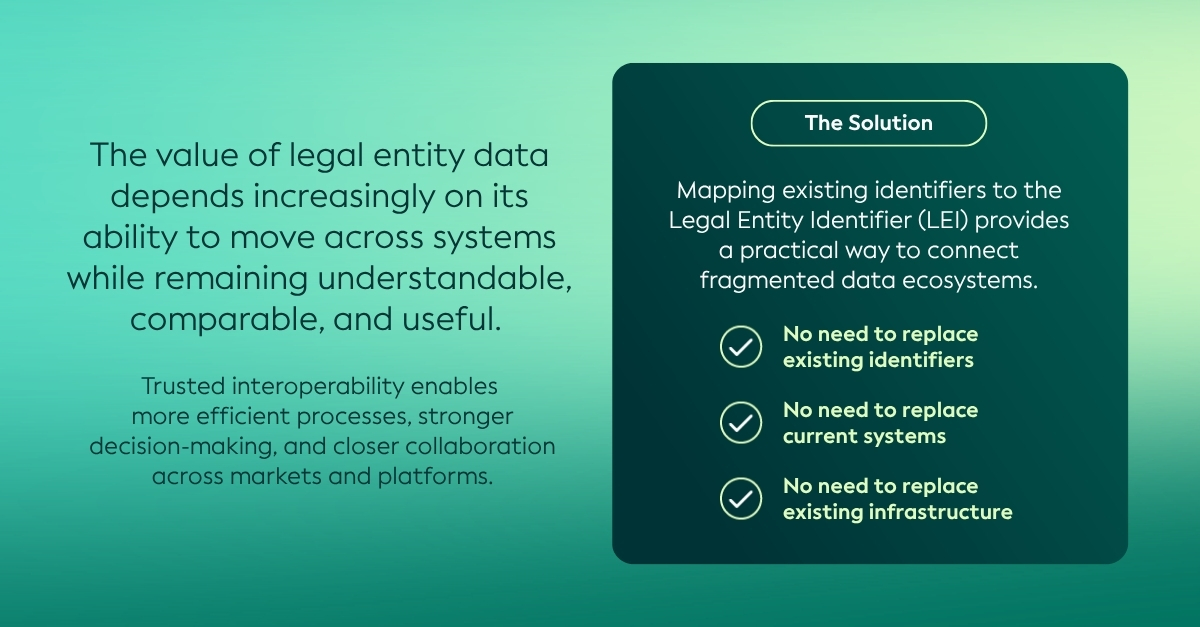
The value of data increasingly depends on how easily it can be combined and applied beyond the system in which it was originally created. As organizations rely on information from a growing range of sources, such interoperability has become essential to supporting efficient processes, informed decisions, and trusted collaboration. This requires more than simply transferring data: information must remain understandable, comparable, and useful when it is shared.
Legal entity data provides a clear example of this challenge. The same organization may appear under different identifiers across markets, platforms, and data providers, making it difficult to determine whether separate records refer to the same entity. This fragmentation can create additional reconciliation work, weaken data quality, and prevent organizations from developing a complete view of their customers, counterparties, and business relationships.
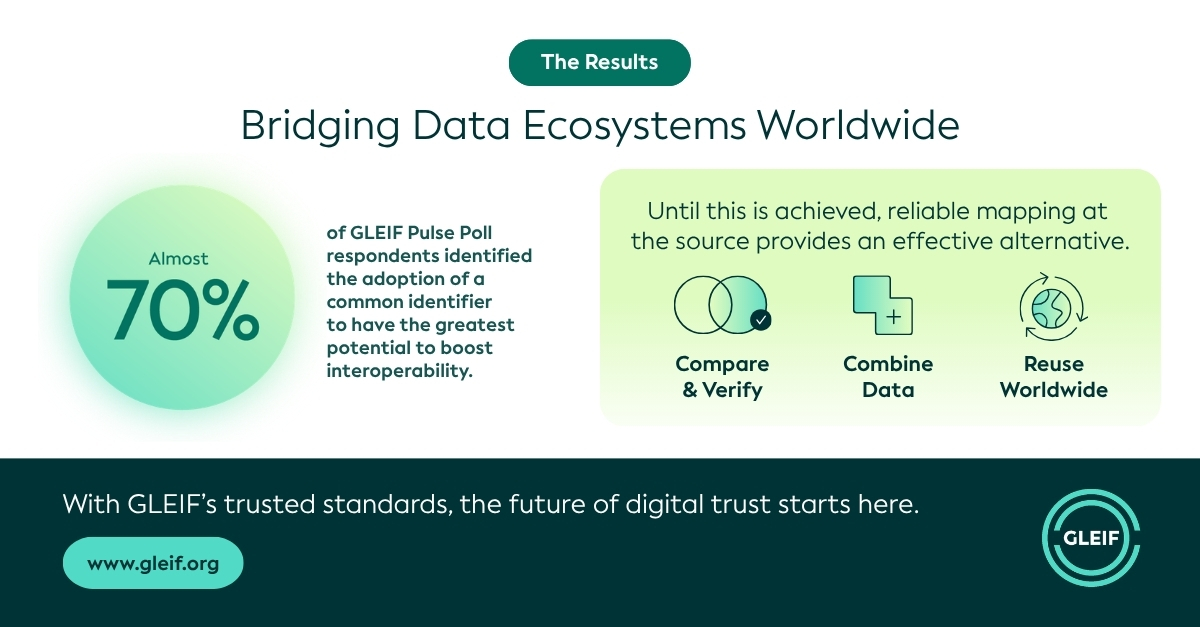
The results of the latest Pulse Poll reinforce the importance of establishing a shared reference point across data ecosystems. Almost 70% of respondents identified adopting a common identifier as the approach with the greatest potential to improve interoperability. Until this is achieved, reliable mapping at the source remains the most effective alternative.
Understanding the benefits of LEI mapping
Mapping existing identifiers to the Legal Entity Identifier (LEI) offers a practical way to bridge the differences between systems. By connecting established identification systems to a common reference point, LEI mappings allow organizations to link and compare records without replacing the identifiers or infrastructure they already use. As their coverage expands, mappings can improve entity resolution, simplify data integration, and make legal entity information more useful across a wider range of processes.
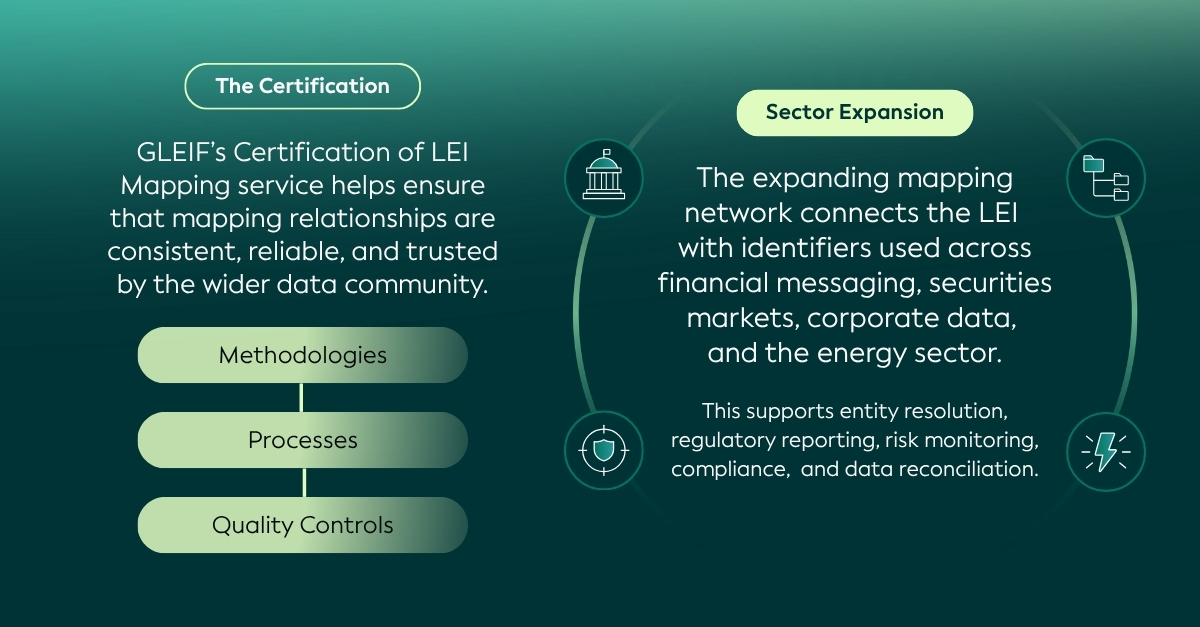
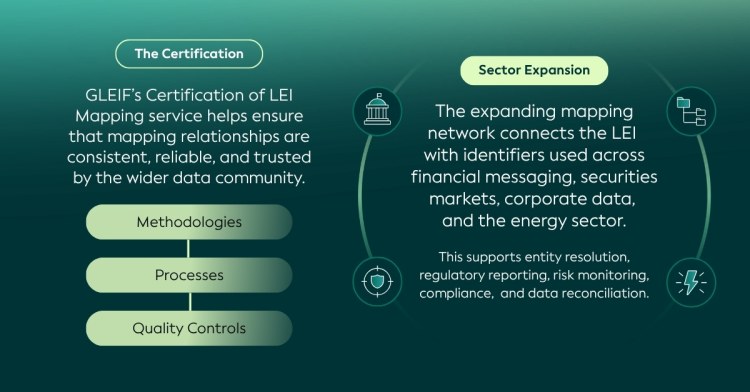
However, the value of a mapping depends on the reliability of the connection it creates. Through its Certification of LEI Mapping service, GLEIF assesses the methodologies, processes, and quality controls used by organizations when linking their identifiers to the LEI. This provides more confidence that mapping relationships are created consistently and can be used reliably by the wider data community.
Strengthening and expanding the mapping network
The value of the mapping network increases as its coverage grows. Since the publication of the previous mapping network blog in October 2025, existing mappings have continued to expand alongside the introduction of new mapping relationships. Together, these developments play an important role in extending interoperability and making LEI data more useful across a broader range of applications.
Here is a summary of key updates to GLEIF's LEI mapping network since October 2025:
SWIFT
GLEIF currently maintains certified LEI mapping services that connect the LEI to both the Business Identifier Code (BIC) and the Market Identifier Code (MIC), which SWIFT manages. Together, these mappings support regulatory reporting, counterparty aggregation, risk monitoring, and data reconciliation.
The number of BIC-to-LEI relationships has increased by 0.3% from 39,211 to 39,338. These mappings connect identifiers used in financial messaging and payments with standardized legal entity data.
MIC-to-LEI coverage also increased by 1.5% from 1,001 to 1,016, strengthening the connection between market and trading-venue identifiers and their corresponding legal entities.
Association of National Numbering Agencies (ANNA)
Mapping International Securities Identification Number (ISIN) codes to LEIs shows which legal entity issued each security. It provides users with a clearer view of the relationship between financial instruments and their issuers. This can improve transparency and support more consistent analysis across capital markets.
ISIN-to-LEI coverage has expanded from 7,441,649 mappings, covering 94,015 unique issuers, to 9,040,992 mappings across 98,292 issuers. This represents a 21.5% increase in mapped relationships and approximately a 4.5% increase in the number of issuers covered.
S&P Global Market Intelligence
The S&P CIQ Company ID-to-LEI relationship file has grown by 9.9%, from 3,056,323 records to 3,358,416. By linking a widely used proprietary company identifier to the LEI, the mapping helps organizations align their internal records with globally standardized entity information, supporting compliance, risk assessment, and regulatory reporting.
OpenCorporates
The number of LEI records connected to the OpenCorporates database increased by 8.3%, from 1,529,589 to 1,656,117. This mapping brings together LEI data and company information collected from corporate registries across numerous jurisdictions, making it easier to verify entities and connect records across open datasets.
Qichacha (QCC)
This mapping connects identifiers used within China’s corporate data environment to globally recognized LEIs, supporting cross-border compliance, market research, and analysis involving China-based entities.
The QCC-to-LEI mapping has declined slightly by 0.1%, from 1,930,040 to 1,927,624 relationships. However, this small movement highlights the value of actively maintained relationship files, in which mappings are continuously reviewed, updated, and removed when they are no longer valid.
Global Energy Monitor (GEM)
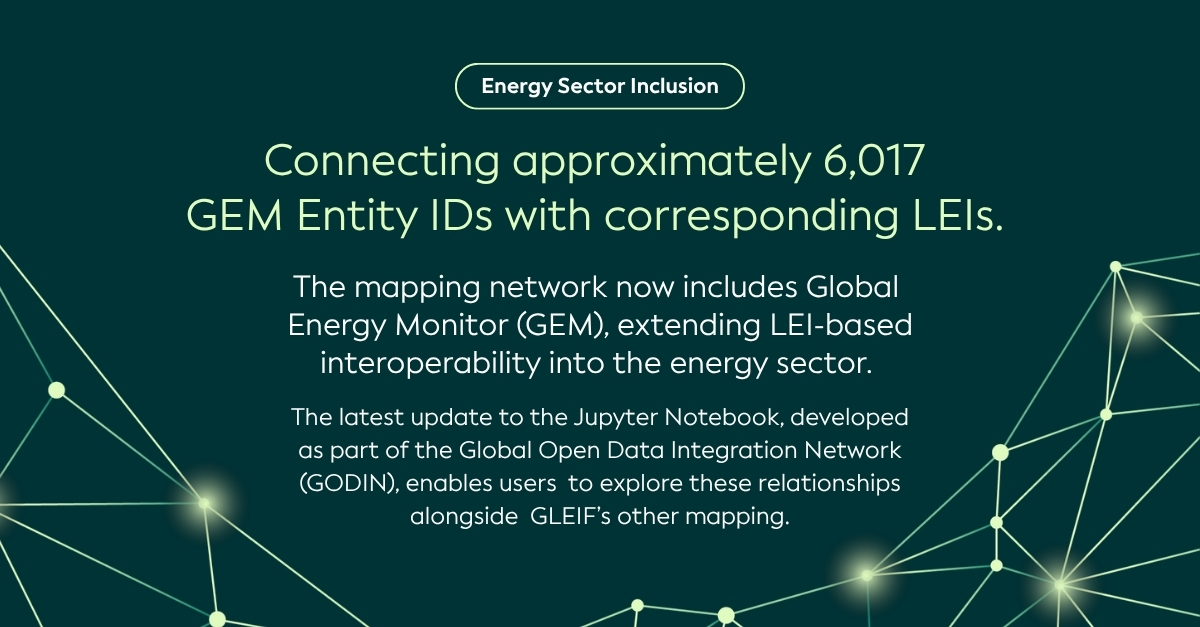
GLEIF and GEM have introduced a certified mapping between the GEM Entity ID and the LEI, helping users link energy-sector information to standardized legal-entity data. This can support more consistent entity identification and make energy-related datasets easier to combine with information from other markets and systems.
Published monthly as an open-data mapping file, the mapping connects approximately 6,017 GEM Entity IDs with corresponding LEIs. The latest version of the Jupyter Notebook also incorporates this newest mapping addition, allowing users to explore how GEM Entity IDs connect to corresponding LEIs alongside the other available mappings.
Mapping as an enabler of interoperability
Mappings play an important role in advancing data interoperability by creating trusted links between identifiers that already exist across different systems and markets. This enables legal entity information to be compared, reconciled, and reused with greater confidence. It can reduce duplication of effort, improve entity verification, and help users combine data from sources that were not originally designed to work together.
As existing relationship files expand and new mapping partners join the network, the LEI becomes an increasingly effective bridge between data ecosystems. Each trusted connection strengthens the foundation for more transparent, efficient, and interoperable use of legal entity data worldwide.
If you would like to comment on a blog post, please identify yourself with your first and last name. Your name will appear next to your comment. Email addresses will not be published. Please note that by accessing or contributing to the discussion board you agree to abide by the terms of the GLEIF Blogging Policy, so please read them carefully.
Zornitsa Manolova has been leading GLEIF’s Data Quality Management and Data Science team since April 2018, responsible for safeguarding and continuously improving data quality and governance across the Global LEI System by using advanced analytics to turn complex data into trusted infrastructure. With a long-standing focus on artificial intelligence and machine learning dating back to her university studies, Zornitsa has consistently applied cutting-edge analytical techniques to complex, real-world data challenges. Before joining GLEIF, she managed international forensic data analytics projects at PwC Forensics, supporting large-scale financial investigations and developing sophisticated approaches to entity resolution, anomaly detection, and data-driven insights.