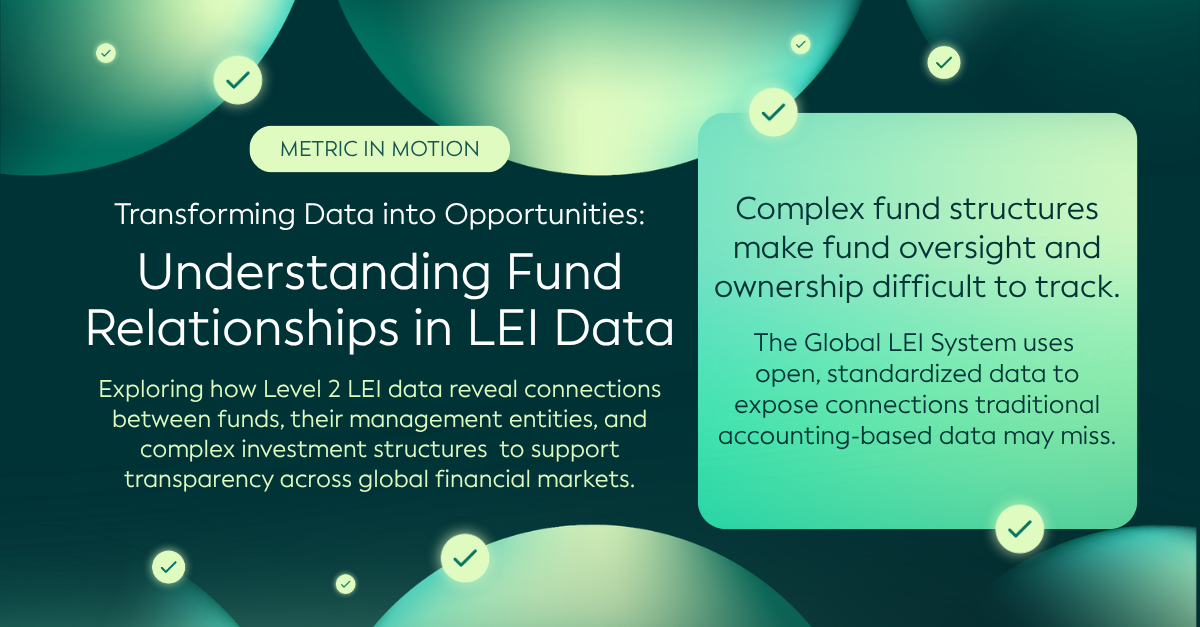
Transforming Data into Opportunities: Metric in Motion – Understanding Fund Relationships using LEI Data
Investment fund structures can be complex, which makes easy access to clear fund relationship data highly valuable for regulators, financial institutions and investors. In this blog, Zornitsa Manolova, Head of Data Quality Management and Data Science at GLEIF, outlines how the Global LEI System reveals connections between funds, their management entities, and their structures to promote greater transparency across financial markets.
Author: Zornitsa Manolova
Date: 2026-11-06
Views:
Investment funds are integral to global financial markets. They bring together capital and invest it in assets such as shares, bonds, and other financial instruments. Some funds operate independently, while others are part of larger, more complex structures involving multiple funds and management entities. This can make it difficult to understand who is responsible for funds and to accurately assess risk and exposure.
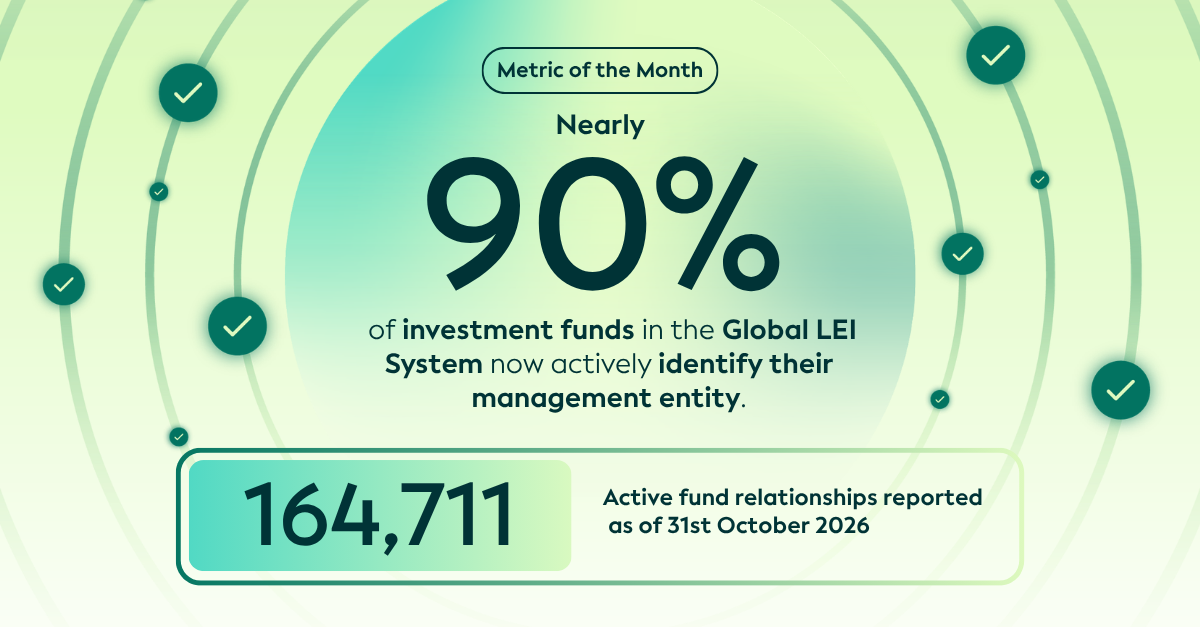
The Global LEI System addresses these challenges. It offers regulators, financial institutions, and investors greater transparency into how funds are organized and managed by making it easier to identify and understand the connections between funds and the entities responsible for them. Today, nearly nine in ten investment funds identify their management entity through LEI relationship data, highlighting the extent of fund management information available through the Global LEI System.
How the Global LEI System identifies fund relationships
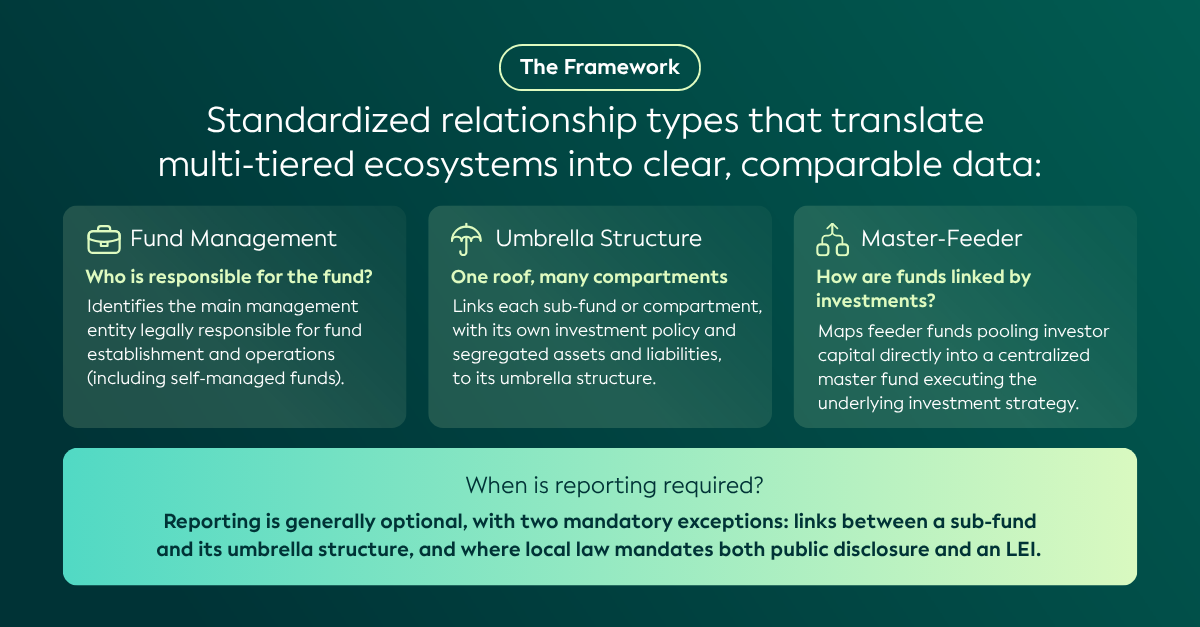
The Global LEI System complements traditional ownership information by recognizing three types of standardized fund relationships: Fund Management, Umbrella Structure, and Master-Feeder.
Fund Management: Who is responsible for the fund?
Investment funds often have a management entity that establishes and operates them. This entity oversees the fund’s activities and may appoint other parties to carry out certain responsibilities. The Fund Management relationship identifies the main management entity legally responsible for a fund. In a self-managed fund, the fund itself can act as its own management entity.
Umbrella Structure: One roof, many compartments
An Umbrella Structure is a legal entity comprising one or more sub-funds or compartments. Each compartment has its own investment objectives, policies, strategy, and investors, with assets and liabilities segregated from those of other compartments. When a sub-fund or compartment has its own LEI, the Umbrella Structure relationship links it to its umbrella, making it easier to see how individual funds fit into the larger structure.
Master-Feeder: How are funds connected through investments?
A Master-Feeder structure connects funds through their investments. A feeder fund invests all or nearly all of its assets in a Master Fund, which runs the main investment strategy.
For example, several feeder funds may collect investments from different investor groups and invest them in the same Master Fund. The Master-Feeder relationship helps users identify these connections and better understand how funds are linked through their investment structures.
Under the Global LEI System, fund relationship reporting is generally optional, with two important exceptions. Relationships between Umbrella Structures and their sub-funds or compartments must be reported. It is also mandatory when the applicable jurisdiction requires public disclosure of the relationship and the related entity to hold an LEI.
Introduced in March 2022, fund relationship reporting has become an established component of the Global LEI System, with 164,711 reported fund relationships as of 31 October 2026.
Why reporting on fund relationships is important
Fund relationship data provides regulators, financial institutions, and investors across financial markets with information they can access and use. This unlocks:
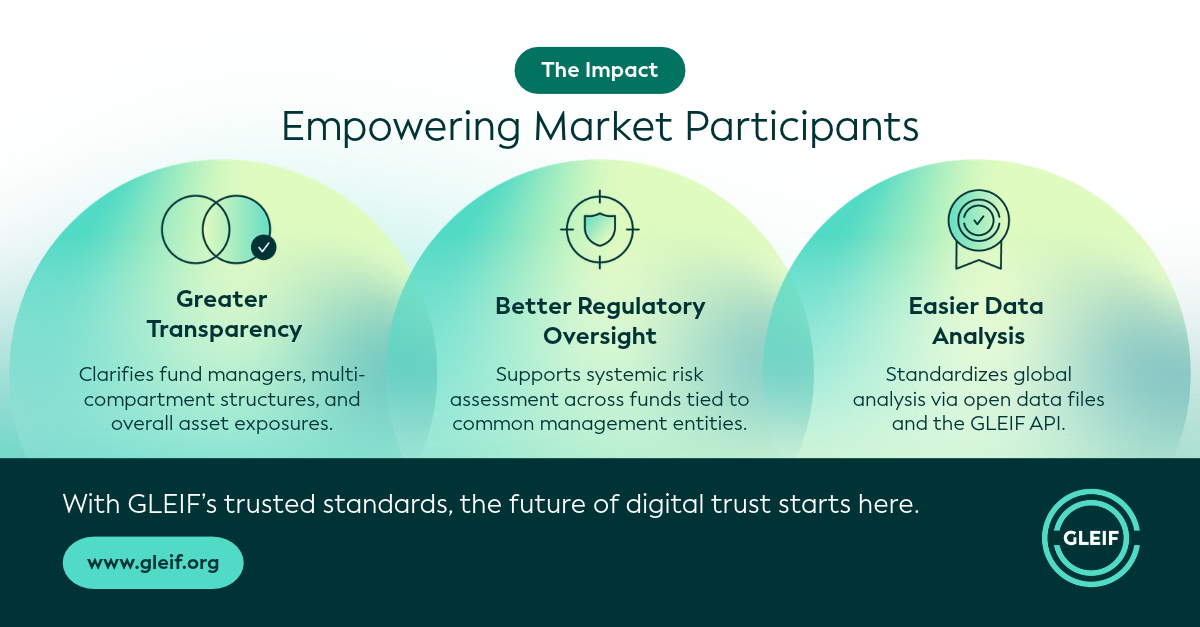
Greater transparency: It helps users understand how funds are connected, who is responsible for managing them, and how they fit within larger structures.
Better regulatory oversight: Regulators can use this information to understand connections and assess related risks, for example, by seeing every fund linked to a single management company and assessing their combined exposures.
Easier data analysis: Standardized LEI data makes it easier to connect information across different sources and systems, supporting more consistent analysis of fund structures. The GLEIF API and data files also support querying the same relationships.
Unlocking a clearer view of the global fund landscape
Fund relationships give the investment world the structural transparency that accounting parents gave corporate groups. By identifying connections to Fund Management entities, Umbrella Structures and Master Funds, they help regulators, financial institutions and investors better understand how funds are managed and organized.
As reporting becomes more widespread, this information can provide an increasingly useful view of fund structures, enabling more informed decision-making and a clearer picture of the global fund landscape.
If you would like to comment on a blog post, please identify yourself with your first and last name. Your name will appear next to your comment. Email addresses will not be published. Please note that by accessing or contributing to the discussion board you agree to abide by the terms of the GLEIF Blogging Policy, so please read them carefully.
Zornitsa Manolova has been leading GLEIF’s Data Quality Management and Data Science team since April 2018, responsible for safeguarding and continuously improving data quality and governance across the Global LEI System by using advanced analytics to turn complex data into trusted infrastructure. With a long-standing focus on artificial intelligence and machine learning dating back to her university studies, Zornitsa has consistently applied cutting-edge analytical techniques to complex, real-world data challenges. Before joining GLEIF, she managed international forensic data analytics projects at PwC Forensics, supporting large-scale financial investigations and developing sophisticated approaches to entity resolution, anomaly detection, and data-driven insights.