Planned maintenance: Brief service interruptions may occur between 19 October and 4 November 2026.
News & Media
GLEIF Blog
Transforming Data into Opportunities: Metric in Motion – Viewing Data by What's Changed
LEI reference data changes as organizations update their names, addresses, registration details, and other information. In this blog, Zornitsa Manolova, Head of Data Quality Management and Data Science at GLEIF, explains two practical ways for data users to identify what has changed within an entity, by comparing GLEIF Golden Copy and Delta Files and using the GLEIF API to inspect recent updates to individual LEI records. A supporting Jupyter notebook shows how these approaches can be put into practice.
Author: Zornitsa Manolova
Date: 2026-10-07
Views:
Every Legal Entity Identifier (LEI) record is linked to reference data about its corresponding entity. This includes, among other data points, the entity's legal name and other names, legal form and jurisdiction, address information, and registration status.
Reference data is not static; it changes as legal entities change. A company may move, change its legal name or form, update its registration status, parent entity, or undergo a corporate event. LEI data must keep pace with these changes to ensure the accuracy of the global LEI data pool and to maintain trust in the Global LEI System.
In addition to the obligatory annual renewal process, in which LEI Issuers re-verify data for the entities they are responsible for, changes to LEI reference data can also be identified through the publicly available Challenge LEI Data service. In addition, GLEIF processes external data sources daily and compares them against existing LEI records. Where potential discrepancies are identified, GLEIF can trigger an update request to the organization managing the LEI.
Keeping LEI data current is only part of the story, however. Data users also need to know what has changed. The timeliness and currency of LEI data are central to its usefulness. Quickly identifying what changed and when, particularly for entities of interest, can help users validate changes and update their own systems with greater confidence.
Metric in Motion: how much does LEI data change?
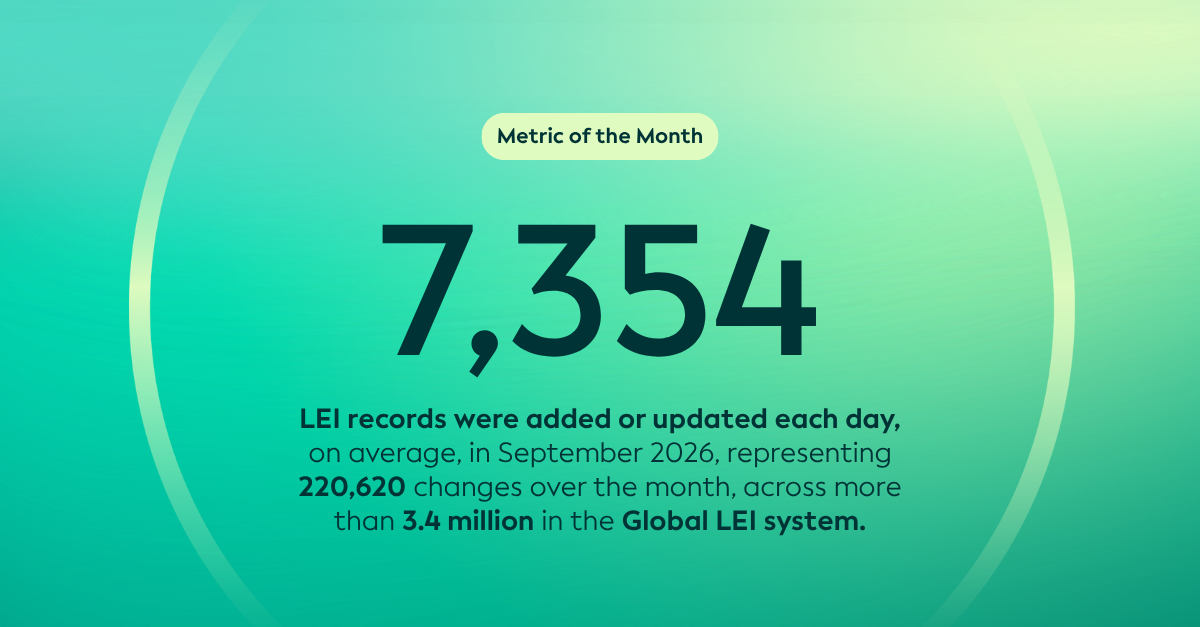
On average over the past month, 7,354 LEI records were added or changed each day, for about 220,620 changes across the month. Isolating these changes, rather than repeatedly processing the full LEI dataset, can therefore make a significant difference for data users.
GLEIF makes LEI data available in different forms to support different user needs. Two commonly used file types are:
Golden Copy Files: provide a complete snapshot of published LEI data at a particular point in time.
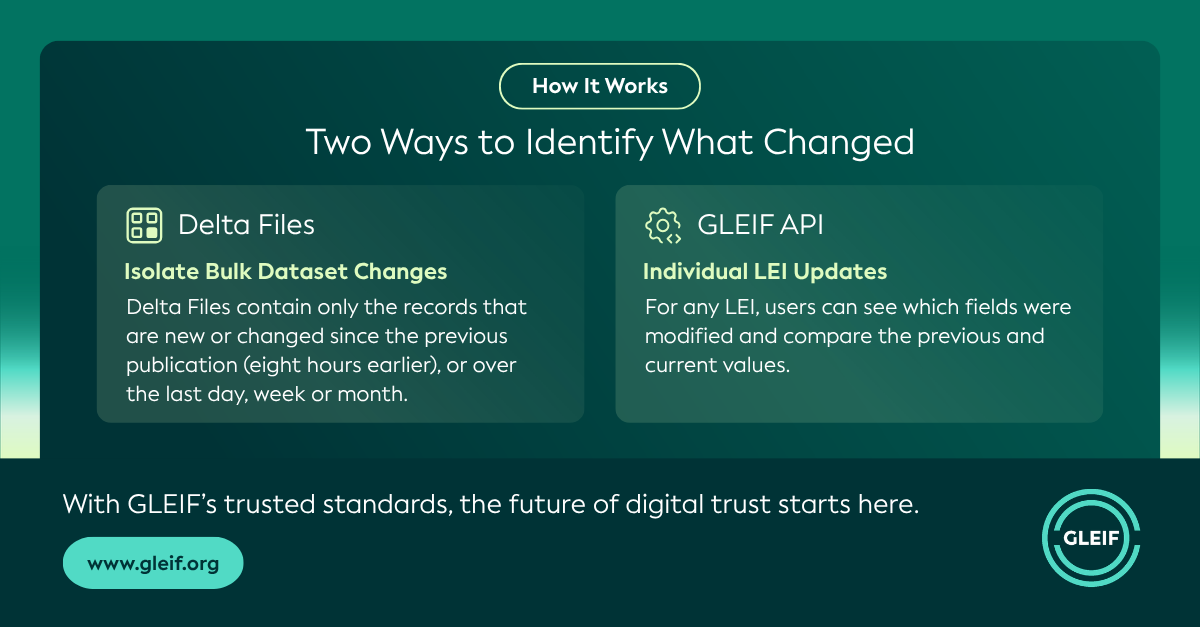
Delta Files: contain records that have been added or changed since a previous publication, allowing users to focus on updates rather than processing the complete dataset again.
GLEIF also provides access to LEI data through the GLEIF API, which allows users and applications to retrieve individual LEI records and related information programmatically.
For users working with LEI data, the challenge is often not accessing the data itself but quickly identifying and understanding the changes.
This article explores two practical ways to identify LEI data changes: by leveraging the Delta Files and by using the GLEIF API to review the most recent field modifications for an LEI. Both approaches help turn a large volume of data into a much simpler question: what changed, and what was the value before and after the change?
A supporting Jupyter notebook is also available, providing a practical implementation of these approaches.
What is in a Delta File?
While the Golden Copy provides a complete view of LEI data at a given point in time, Delta Files contain only records that have changed or been added since the previous publication. By reviewing the LEIs in a Delta File, users can quickly determine whether an LEI is:
Newly added
Already present but updated
Where records have been modified, GLEIF highlights the specific fields that changed and shows both the previous and current values side by side. For example, a user might see that an LEI's legal name remained unchanged, while its legal address, registration status, or parent information has been updated. This lets users focus only on what requires attention, instead of reviewing the complete record again, which can save valuable time.
Checking changes through the GLEIF API
The GLEIF API provides another way to understand recent LEI updates. Instead of comparing two downloaded files, the API can provide the recorded field modification history for an LEI. This lets you identify the most recent changes to an entity without manually processing the full Golden Copy and Delta Files.
For a simpler user experience, you can first identify the latest modification date and display only the fields changed on that date. This makes it easier to answer questions such as:
What changed most recently for this LEI?
Which fields were updated?
What were the previous and current values?
Making changes easier to understand
Raw field names and change records can be difficult to interpret, especially for users unfamiliar with the underlying data structure. Grouping changes into meaningful categories can make the results much easier to review. Examples of these categories include:
Entity / Legal Identity
Legal Address
Headquarters Address
Registration / Validation
Legal Entity Events
Relationships / Reporting Exceptions
This lets users focus on the reason for a change rather than the source data structure.
Benefits
These approaches allow data users to access and interpret the data for the entities they care about more efficiently. It does this by enabling:
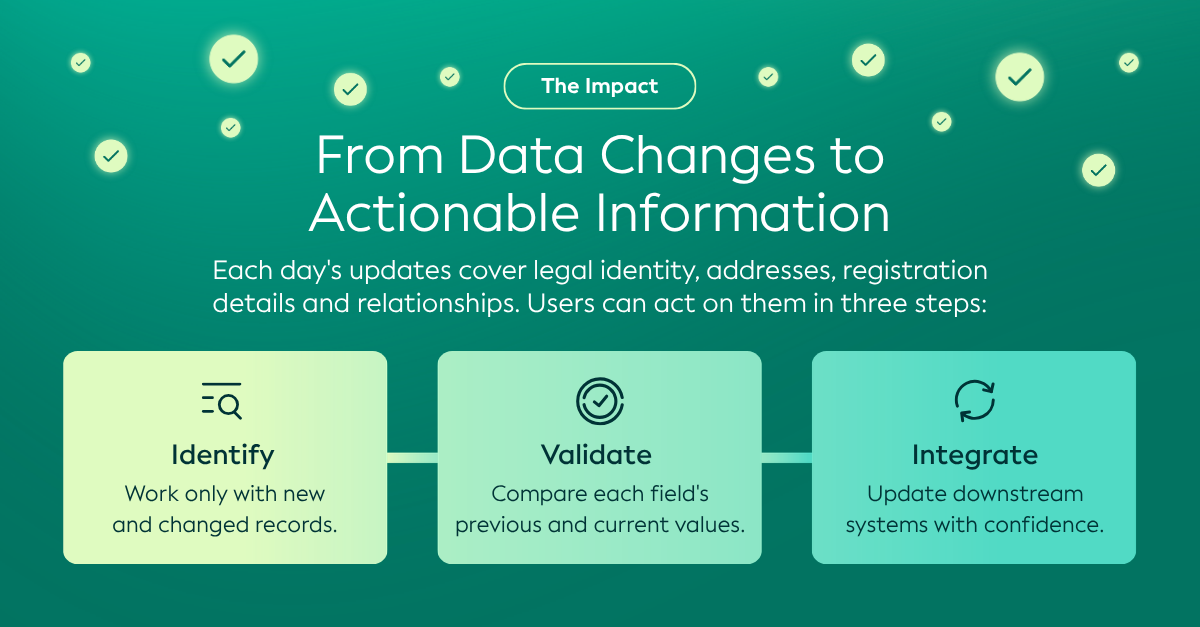
Faster identification of changes: users can filter data to only reveal the records and fields that changed, without processing the entire dataset.
Clear identification of new LEIs: new records can be easily distinguished from updates to existing records.
Easier validation: previous and current values can be viewed side by side.
Clearer results: changes can be grouped into familiar business categories instead of exposing only technical field paths.
More focused monitoring: based on their own risk profiles, users can monitor selected entities and focus on changes that are relevant to their processes.
A practical way to explore LEI updates
These two approaches serve different and complementary purposes. The Delta Files are useful when working with published files and validating which records have changed between datasets. The API approach is useful when you want to quickly inspect the most recent recorded changes for individual LEIs. Together, they provide a practical way to move from large LEI datasets to a clear view of what changed, making LEI data easier to access, review, and understand. For users who maintain entity data in their own systems, these approaches can turn LEI data changes from something to process into something they can act on.
If you would like to comment on a blog post, please identify yourself with your first and last name. Your name will appear next to your comment. Email addresses will not be published. Please note that by accessing or contributing to the discussion board you agree to abide by the terms of the GLEIF Blogging Policy, so please read them carefully.
Zornitsa Manolova has been leading GLEIF’s Data Quality Management and Data Science team since April 2018, responsible for safeguarding and continuously improving data quality and governance across the Global LEI System by using advanced analytics to turn complex data into trusted infrastructure. With a long-standing focus on artificial intelligence and machine learning dating back to her university studies, Zornitsa has consistently applied cutting-edge analytical techniques to complex, real-world data challenges. Before joining GLEIF, she managed international forensic data analytics projects at PwC Forensics, supporting large-scale financial investigations and developing sophisticated approaches to entity resolution, anomaly detection, and data-driven insights.