Planned maintenance: Brief service interruptions may occur between 19 October and 4 November 2026.
News & Media
GLEIF Blog
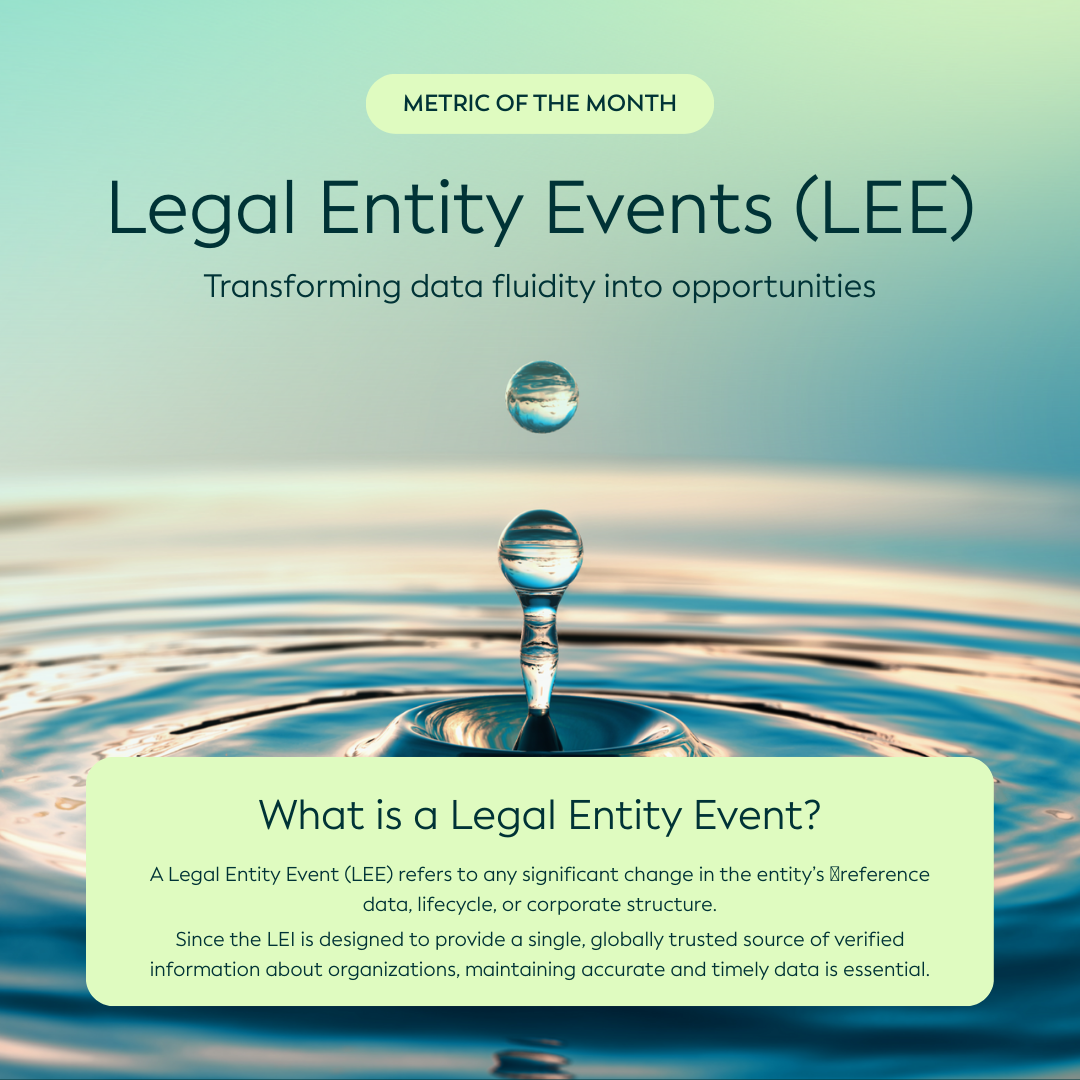
Transforming Data into Opportunities: Metric of the Month – Legal Entity Events
High-quality data is more than a benchmark – it is a strategic necessity for global trust, compliance and interoperability. In this blog, Zornitsa Manolova, Head of Data Quality Management and Data Science at GLEIF, highlights the critical importance of tracking Legal Entity Events to ensure that LEI data remains reliable, up-to-date, and fit for global use.
Author: Zornitsa Manolova
Date: 2025-12-05
Views:
In an increasingly interconnected global economy, the ability for organizations to trust and use data effectively is the foundation for innovation, growth, and competitiveness.
A high-quality data ecosystem is a driver of change and innovation that enables organizations to identify and seize new opportunities. At the same time, low data quality can lead to inefficiencies and expose the organization to regulatory and reputational risks.
GLEIF is committed to optimizing the quality, reliability, and usability of LEI data. Since 2017, it has published dedicated monthly reports to transparently demonstrate the overall level of data quality achieved in the Global LEI System.
To aid broader industry understanding and awareness of GLEIF’s data quality initiatives, this new blog series explores key metrics included within the reports.
This month’s blog examines Legal Entity Events.
The Legal Entity Identifier (LEI) is designed to provide a single, globally trusted source of verified information about organizations. But organizations can change quickly. Tracking and reporting these changes – known as Legal Entity Events – is critical to preserving the integrity and accuracy of the LEI as a global identifier.
What is a Legal Entity Event?
A Legal Entity Event, as defined by the Regulatory Oversight Committee (ROC), refers to any significant change in an entity’s reference data, lifecycle, or corporate structure. Legal Entity Events capture a range of corporate actions that can affect how an organization operates, how it is recognized by regulators, or how it participates in the financial ecosystem. There are currently 20 types of Legal Entity Events, including changes in ownership, mergers and acquisitions, name or address changes, and entity termination.
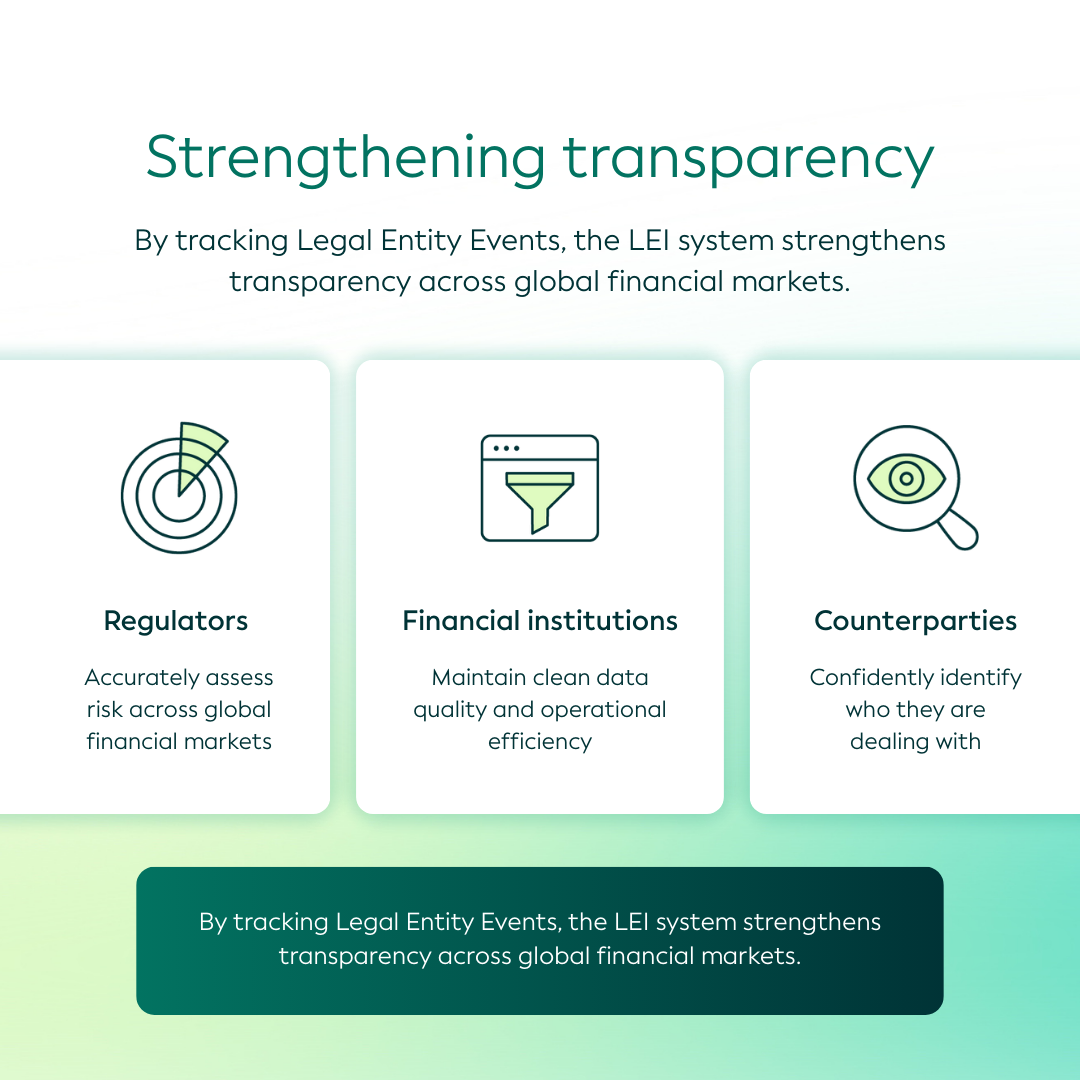
By tracking Legal Entity Events, the Global LEI System can continue to strengthen transparency across global financial markets. Accurate event reporting helps regulators assess risk, financial institutions maintain clean data, and counterparties confidently identify who they are dealing with.
Reporting Legal Entity Events
Whenever a Legal Entity Event occurs, it must be promptly reported to the entity’s issuing Local Operating Unit (LOU). Each Legal Entity Event is reported using a set of structured attributes that provide clarity and context:
Event Status: indicates where the event stands within its lifecycle or timeline.
Group ID: an identifier assigned to link events that are part of the same group of multiple or complex events.
Group Sequence Number: shows the order in which events occur within a grouped sequence.
Legal Entity Event Effective Date: the date when the Legal Entity Event becomes legally valid.
Legal Entity Event Recorded Date: the date when the Legal Entity Event is officially captured in the Global LEI System.
Affected Fields: the fields of reference data and its value, which are updated because of the Legal Entity Event.
Validation Documents: type of document for validating the Legal Entity Event.
Validation Reference: specifies the source or document used as the basis for verifying the Legal Entity Event.
Legal Entity Event Type: currently recognizes 20 different types of Legal Entity Events, each grouped by priority to capture the most impactful changes first.
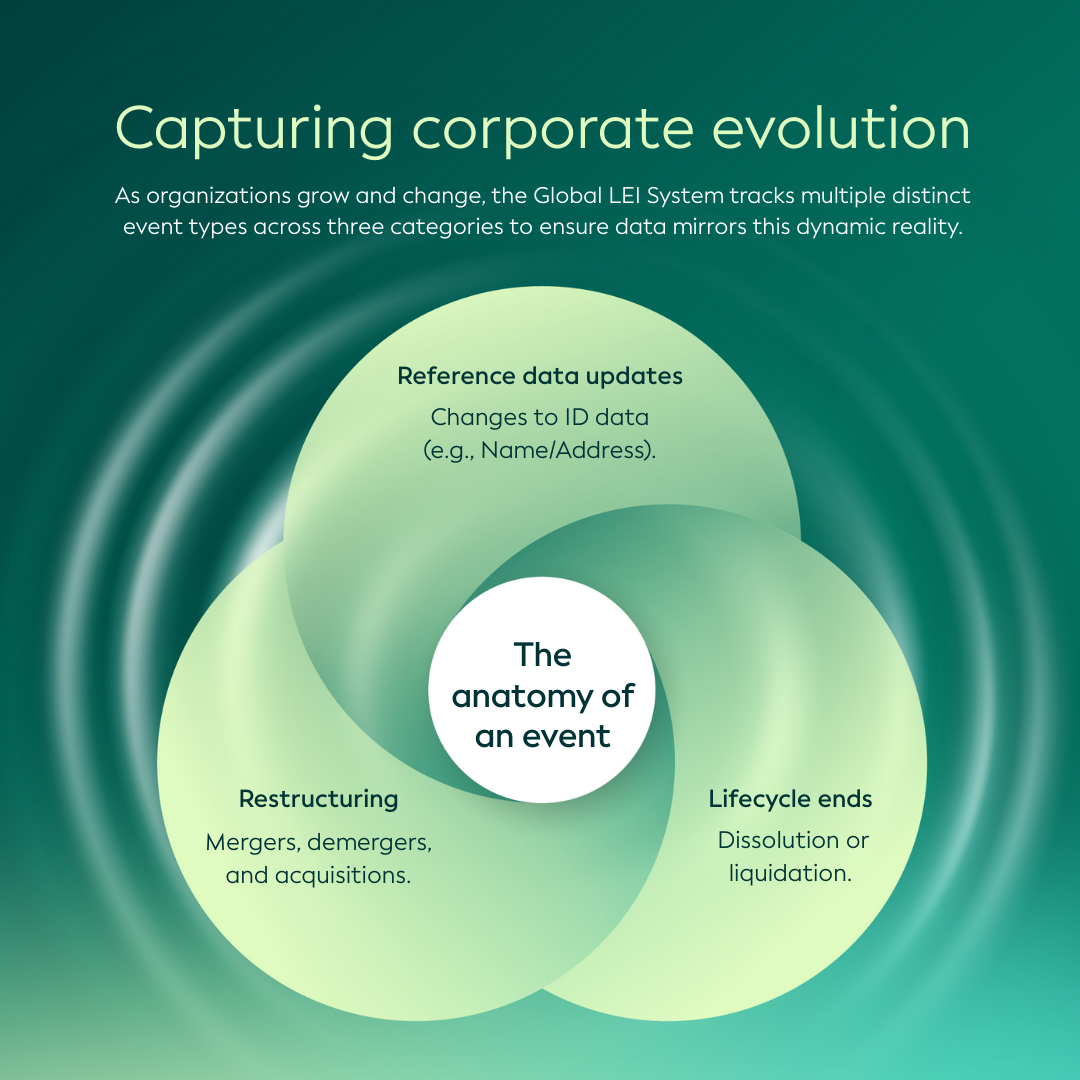
GLEIF then distinguishes between three different categories of events:
Updates to an entity’s reference data, reflecting changes relevant for identifying the entity, while maintaining the entity’s legal continuity and the validity of its existing LEI.
Events that bring an entity’s lifecycle to an end, such as dissolution or liquidation.
Events that create new entities or restructure existing ones, including mergers, demergers, and other transformations.
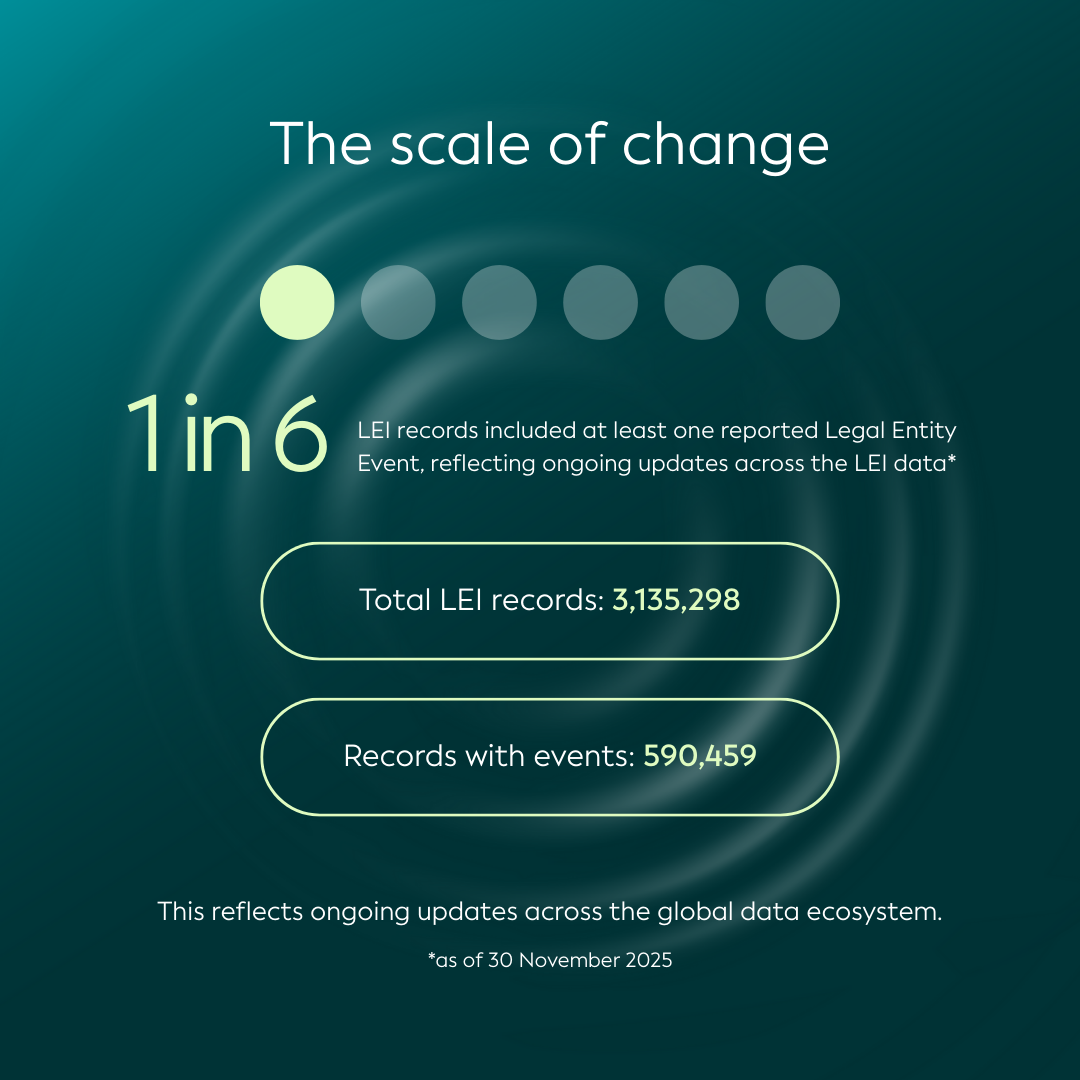
As of 30 November, about one in six LEI records (590,459 out of 3,135,298 total) included at least one reported Legal Entity Event, reflecting ongoing updates across the LEI data. On the same day, 12 new Legal Entity Events were added, highlighting the steady flow of corporate activity being captured. Looking at recently completed events that became effective after 1 November, the average time to their reflection in the LEI data was just 1.6 days. This shows how efficiently new information is being incorporated, helping keep LEI records timely and dependable. To regularly monitor the Legal Entity Events recorded in the system, GLEIF provides a Data Monitoring Dashboard that includes a dedicated View for Legal Entity Events.
Enhancing Legal Entity Event Reporting
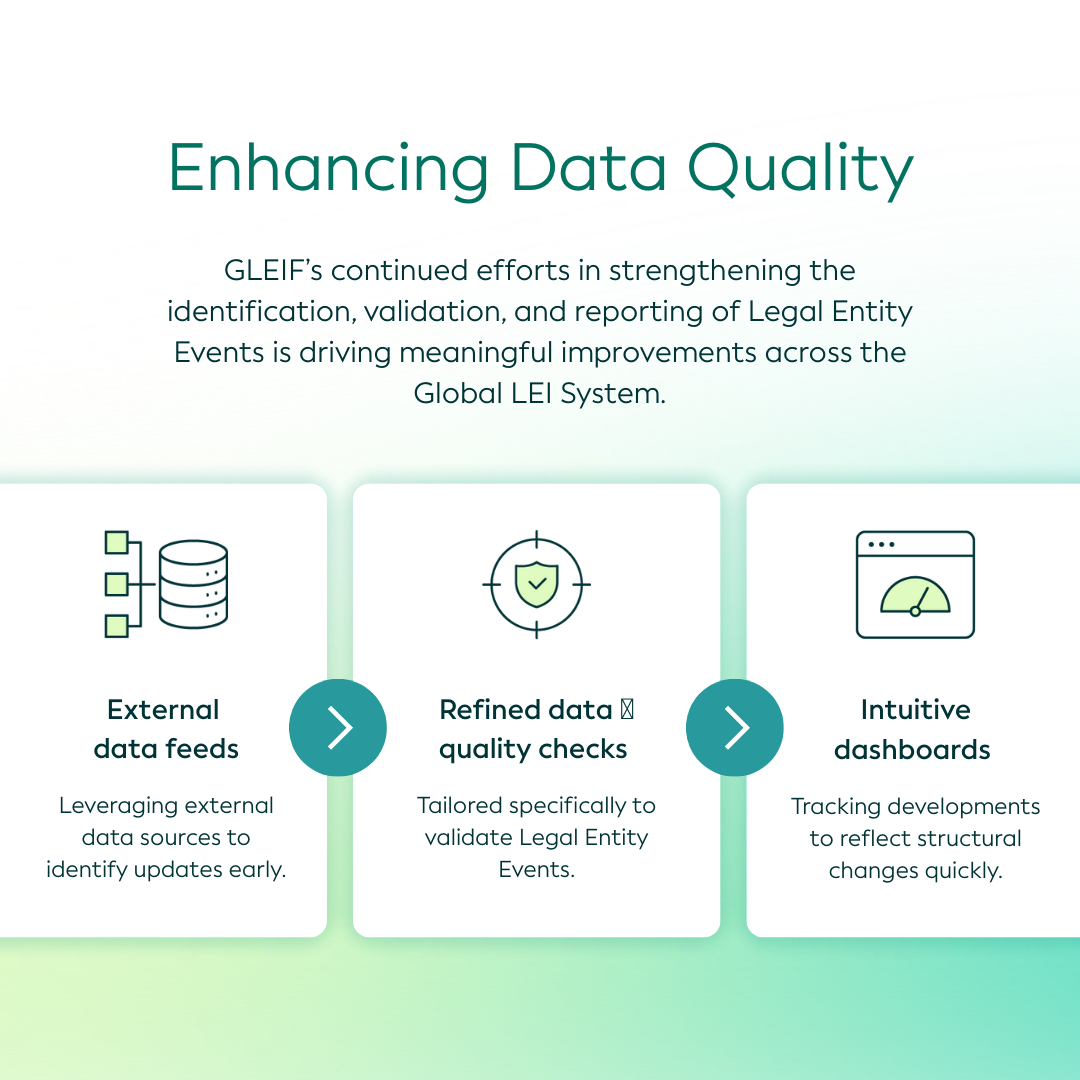
GLEIF is committed to strengthening the identification, validation, and reporting of Legal Entity Events. Through initiatives such as leveraging external Data Feeds, refining Data Quality checks tailored to Legal Entity Events, and tracking new developments through open, intuitive dashboards, the precision and consistency of LEI records are continuing to improve:
Data Feeds
As part of its Data Quality Management framework, GLEIF has integrated so-called 'Data Feeds' to ensure timely Legal Entity Event updates outside of the regular renewal process. Data Feeds are external data sources that provide the latest information on important events affecting legal entities, such as name changes, mergers, and other corporate actions. By receiving this data regularly (e.g., daily or weekly), GLEIF can quickly identify when an LEI record may no longer be up to date. The system then automatically creates bulk challenges for LEI issuers, highlighting the type of event detected and the fields that may need updating. This process helps keep LEI records accurate, timely, and trustworthy, benefiting everyone who relies on high-quality entity data.
Data Quality Checks
GLEIF has developed a dedicated set of Data Quality Checks to ensure that Legal Entity Events are recorded in accordance with the rules of the Global LEI System and to promote accurate and consistent reporting. Examples of these checks include verifying that previous name changes have corresponding events, ensuring that no duplicate events exist, checking the plausibility of dates, and confirming that successor information is available for relevant retired records. In November 2025, the average check failures focusing on Legal Entity Events improved from 14 to 11 compared to the previous reporting month.
Open-Source Code
As part of our ongoing GODIN initiative to foster open data practices and collaboration, the next Jupyter Notebook explores how Legal Entity Events can be used to generate a comprehensive view of entity updates over time. By analyzing these events, users can easily understand what changes occurred, when they happened, and how they impact the lifecycle of an LEI record. This enables more profound insight into retirements, structural adjustments, and other key transitions reflected in historical LEI data. In particular, the open-source code allows data users to link previous values of fields affected by Legal Entity Events or to chain API calls to obtain information not only about the LEI of interest, but also about its successor, if applicable.
Transforming data into opportunities
In today's on-demand world, reactivity and immediacy are key to ensuring that LEI data reflects reality and is fit for global use by financial institutions, regulators, and market participants. Through various initiatives that enable key corporate actions and structural changes to be addressed quickly and accurately, GLEIF is driving meaningful improvements across the Global LEI System and promoting a more open, reliable, and trusted global data ecosystem.
If you would like to comment on a blog post, please identify yourself with your first and last name. Your name will appear next to your comment. Email addresses will not be published. Please note that by accessing or contributing to the discussion board you agree to abide by the terms of the GLEIF Blogging Policy, so please read them carefully.
Zornitsa Manolova has been leading GLEIF’s Data Quality Management and Data Science team since April 2018, responsible for safeguarding and continuously improving data quality and governance across the Global LEI System by using advanced analytics to turn complex data into trusted infrastructure. With a long-standing focus on artificial intelligence and machine learning dating back to her university studies, Zornitsa has consistently applied cutting-edge analytical techniques to complex, real-world data challenges. Before joining GLEIF, she managed international forensic data analytics projects at PwC Forensics, supporting large-scale financial investigations and developing sophisticated approaches to entity resolution, anomaly detection, and data-driven insights.