Planned maintenance: Brief service interruptions may occur between 19 October and 4 November 2026.
News & Media
GLEIF Blog
Transforming Data into Opportunities: Metric in Motion – Unlocking Trusted Entity Data for Cross-Border Payments
High-quality data is more than a benchmark – it is a strategic necessity for global trust, compliance and interoperability. In this blog, Zornitsa Manolova, Head of Data Quality Management and Data Science at GLEIF, explores how the LEI and Global LEI System enables ISO 20022-compliant retrieval of name and address data to support more trusted and transparent cross-border payments.
Author: Zornitsa Manolova
Date: 2026-04-09
Views:
In an increasingly interconnected global economy, the ability for organizations to trust and use data effectively is the foundation for innovation, growth, and competitiveness.
A high-quality data ecosystem is a driver of change and innovation that enables organizations to identify and seize new opportunities, while low data quality can lead to inefficiencies and exposure to regulatory and reputational risks.
To aid broader industry awareness of GLEIF’s data quality initiatives and its application to different sectors, this new blog series explores key metrics included within the reports.
This month’s focus: global payments and the role of the LEI in enabling ISO 20022-compliant address retrieval.
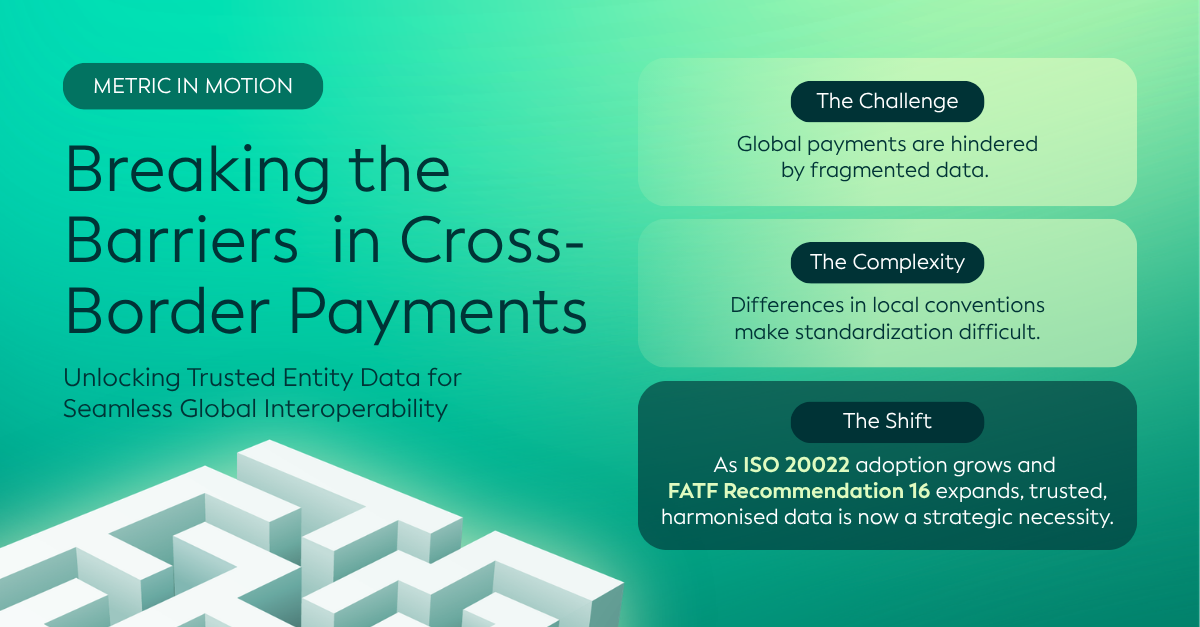
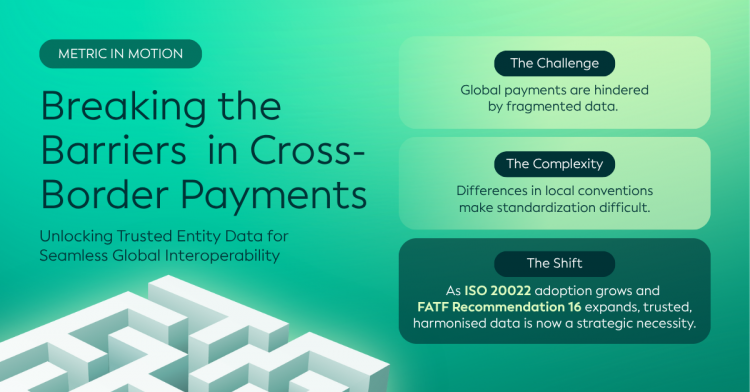
Data quality sits at the heart of any efficient and trustworthy financial system, yet fragmentation remains one of the most persistent challenges inhibiting cross-border payments. Inconsistencies in core entity information, such as names, addresses, and status data – compounded by variations across jurisdictions, systems, and formats – continue to hinder automation, complicate compliance, and slow down cross-border processes.
Regulatory and industry initiatives to enhance cross-border payments are reinforcing the importance of consistent, interoperable reference data for a more connected global payments ecosystem. As adoption of the ISO 20022 messaging standard accelerates and regulatory expectations, such as FATF Recommendation 16, expand, the ability to rely on trusted, harmonized entity data is emerging as a critical enabler of efficient and compliant financial messaging.
As a globally standardized identifier, the Legal Entity Identifier (LEI) is key to expanding access to trusted information about entities. In a recent Pulse Poll, GLEIF asked the global data community: Which specific LEI-based data service would create the most value for your organization with a focus on payments operations? Respondents were equally vocal about the need for services that enable ISO 20022-compliant retrieval of the beneficiary's name and address in both structured and hybrid address formats.
Why Name and Address Formats in ISO 20022 Matter
The inclusion of address data in payment messages has long presented challenges, particularly in cross-border scenarios. Differences in language, format, and local conventions make standardization difficult. Historically, payment systems have relied on free-text fields to accommodate this diversity, which, while flexible, introduces ambiguity that can complicate automation.
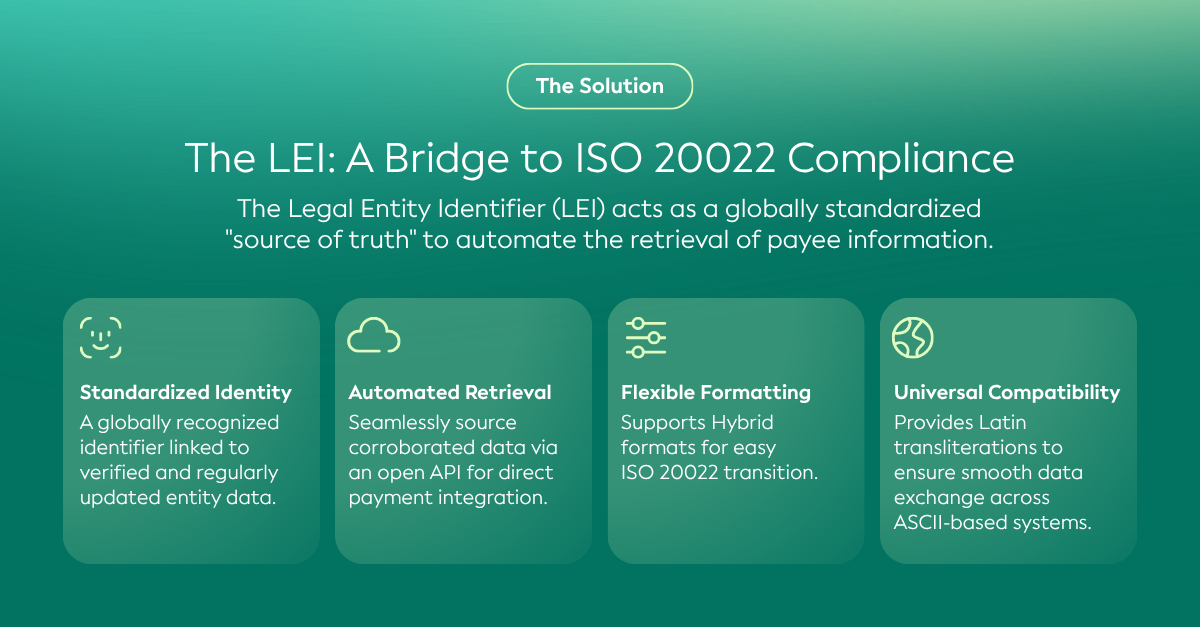
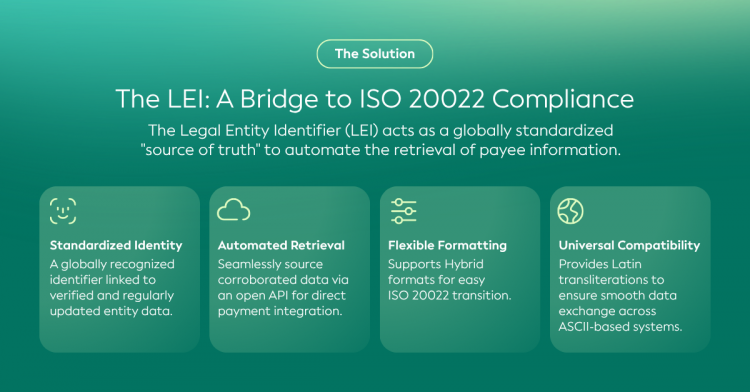
In response, ISO 20022 introduced a structured format for beneficiary information – notably for capturing address information. Though this enables greater detail, the differences in address formats globally mean that fully structured models are not always straightforward to implement in practice. This is why a hybrid option, incorporating both structured and unstructured elements, has been introduced to provide flexibility during the transition to fully structured formats.
Another important consideration is language and script. While names and addresses in their native form remain essential for accurately representing a legal entity, many systems require Latin-based representations. This means that providing consistent Latin translations and transliterations without special characters remains critical to enabling interoperability across ASCII-based systems.
LEI-Based Data Service: Enabling Effective Payee Verification and Seamless Digital Communication
Given these considerations, the LEI is playing a central role in improving efficiency by automating the retrieval of name and address data.
As a globally recognized alphanumeric identifier connected to verified and regularly updated reference data, including legal names and addresses, the LEI introduces a trusted, authoritative foundation accessible to all parties – the originator’s bank, beneficiary’s bank, payments service providers, and financial intelligence units. Instead of relying on fragmented or manually entered information, organizations can use the LEI to source corroborated entity data and integrate it directly into payment messages.
Among the various benefits this delivers – and in response to the industry need outlined in our recent Pulse Poll – it is important to highlight that the LEI simplifies retrieving beneficiaries' names and addresses. This can enable precise, instant, and automatic identification across borders to support more effective and efficient payee verification:
Beneficiary name: LEI data provides consistent name information and Latin transliterations. This supports more reliable automation, reduces ambiguity, and enhances transparency across systems and jurisdictions.
Beneficiary address: The Global LEI System can be used to retrieve ISO 20022 address formats – either hybrid or fully structured. The result is more efficient processing by accommodating the diversity of global address formats.
Let’s see this in action:
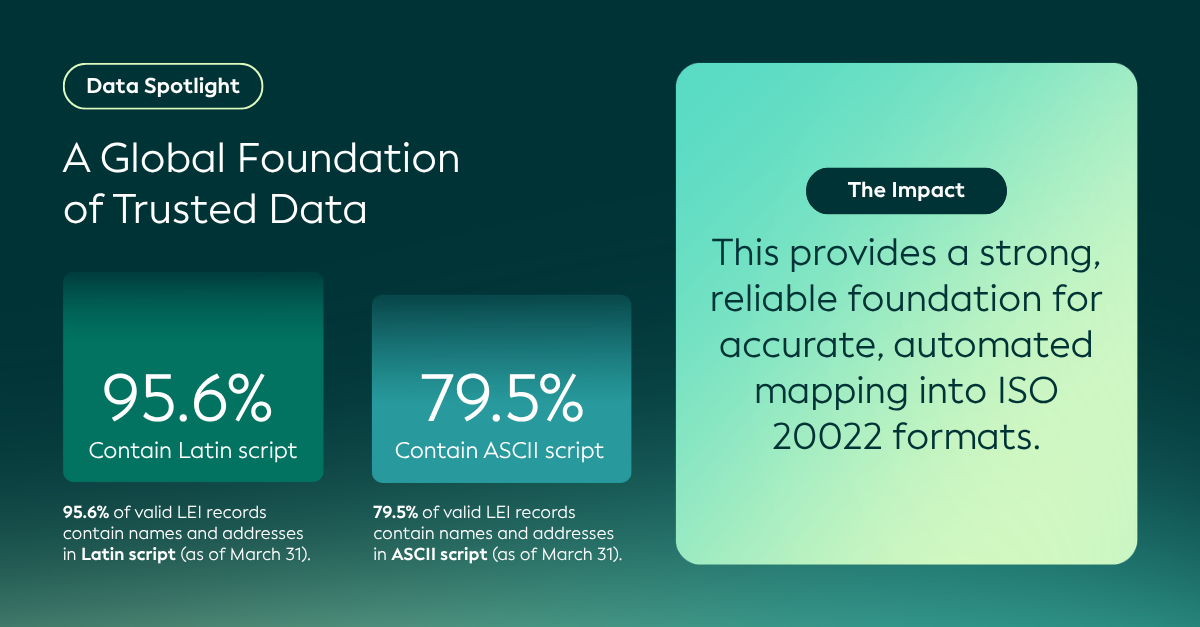
As of March 31, 95.6% of valid LEI records contain names and addresses in Latin script. In addition, 79.5% of valid LEI records use a standardized ASCII character set, providing a strong foundation for ISO 20022–compliant conversion and automated mapping.
Here is the exciting part: this mapping service can be deployed at low cost by financial institutions, payment service providers, or data providers, thanks to the Global LEI System's open API and the public, freely accessible availability of the LEI and its reference data.
To further support integration by financial institutions, payment service providers, and data services providers, an open-source code snippet is available as part of GODIN’s commitment to “implementing a practical approach to utilize Open Data, enabling enhanced transparency and risk assessment”. This practical resource reduces implementation effort, accelerates integration, and helps organizations operationalize LEI data within existing systems.
How to Shape the Future of Cross-Border Payments
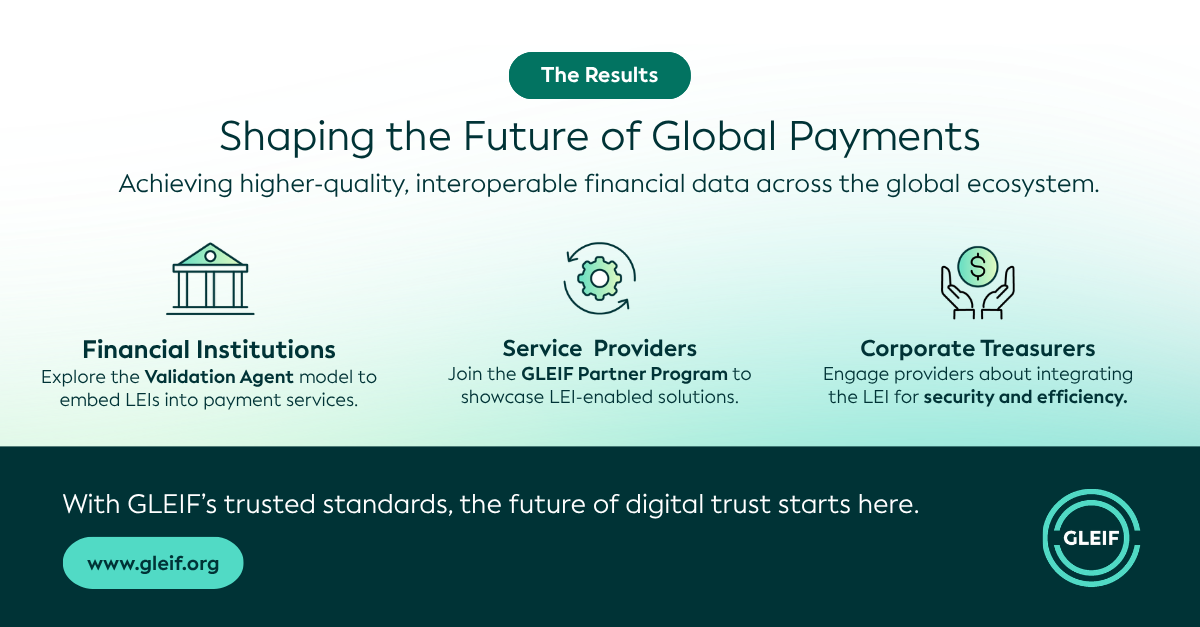
Integrating ISO 20022 and the LEI paves the way for higher-quality, interoperable financial data across the global payments ecosystem. To ensure these benefits are realized at scale by organizations across the world, here is how you can get involved today:
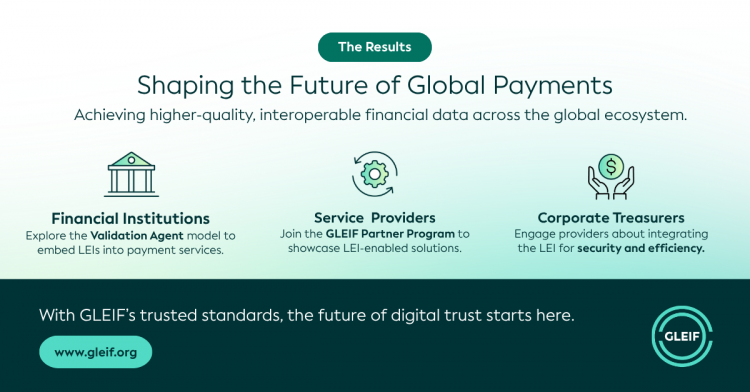
Financial Institutions: Contact GLEIF to explore the Validation Agent model and discover how to embed the LEI into your payment services.
Payment Service Providers and Data Vendors: Join the GLEIF Partner Program to receive regular updates on global system developments and showcase your LEI-enabled solutions on the Partner Program solutions page.
Corporate Treasurers: Engage your service providers about their plans to integrate the LEI to enhance security and efficiency in your payment operations.
If you would like to comment on a blog post, please identify yourself with your first and last name. Your name will appear next to your comment. Email addresses will not be published. Please note that by accessing or contributing to the discussion board you agree to abide by the terms of the GLEIF Blogging Policy, so please read them carefully.
Zornitsa Manolova has been leading GLEIF’s Data Quality Management and Data Science team since April 2018, responsible for safeguarding and continuously improving data quality and governance across the Global LEI System by using advanced analytics to turn complex data into trusted infrastructure. With a long-standing focus on artificial intelligence and machine learning dating back to her university studies, Zornitsa has consistently applied cutting-edge analytical techniques to complex, real-world data challenges. Before joining GLEIF, she managed international forensic data analytics projects at PwC Forensics, supporting large-scale financial investigations and developing sophisticated approaches to entity resolution, anomaly detection, and data-driven insights.