How AEOTrade Is Strengthening Trust in Global Digital Trade with the vLEI
In this blog, Founder of AEOTrade and Secretary-General of the TradeTech Alliance, Zetao Yang, shares his perspectives on how the verifiable LEI (vLEI) and AEOTradeChain can help advance global digital trade, support cross-border interoperability, and address challenges such as identity impersonation and document fraud.
Author: Zetao Yang, Founder of AEOTrade & Sec Gen of TradeTech Alliance
Date: 2026-07-01
Views:
How can cross-border trade become more efficient, secure, and trusted? This challenge motivated AEOTrade to participate in GLEIF’s 2025 vLEI Hackathon, where it was named runner-up in the “Trade, Supply Chain, and MSME Finance” category. Its solution combined the verifiable LEI (vLEI) with blockchain to create a trusted collaboration framework for more reliable, interoperable, and efficient global trade processes.
Building on this momentum, GLEIF and AEOTrade signed a strategic Memorandum of Understanding (MoU) earlier this year. The partnership aims to support the development of an open, secure, inclusive, and globally connected digital trade infrastructure, powered by trusted organizational identity.
In this guest blog, Zetao Yang, Founder of AEOTrade and Secretary-General of the TradeTech Alliance, shares his insights on organizational identity, the vLEI, digital trade, and interoperability.
What first motivated AEOTrade to explore the vLEI as part of its digital trade infrastructure?
Global trade has long faced trust-related challenges, including identity impersonation and document fraud. At the root of these issues is the lack of a globally recognized and verifiable legal entity identity framework. Today, companies often need to submit the same registration documents across multiple platforms and jurisdictions. This process is inefficient, repetitive, and vulnerable to forgery.
The vLEI addresses this core pain point. Built on the globally recognized Legal Entity Identifier (LEI), it gives organizations a secure, verifiable way to control and prove their identity in digital environments. This creates a foundation of trust that starts with verified identity and extends across the entire trade chain.
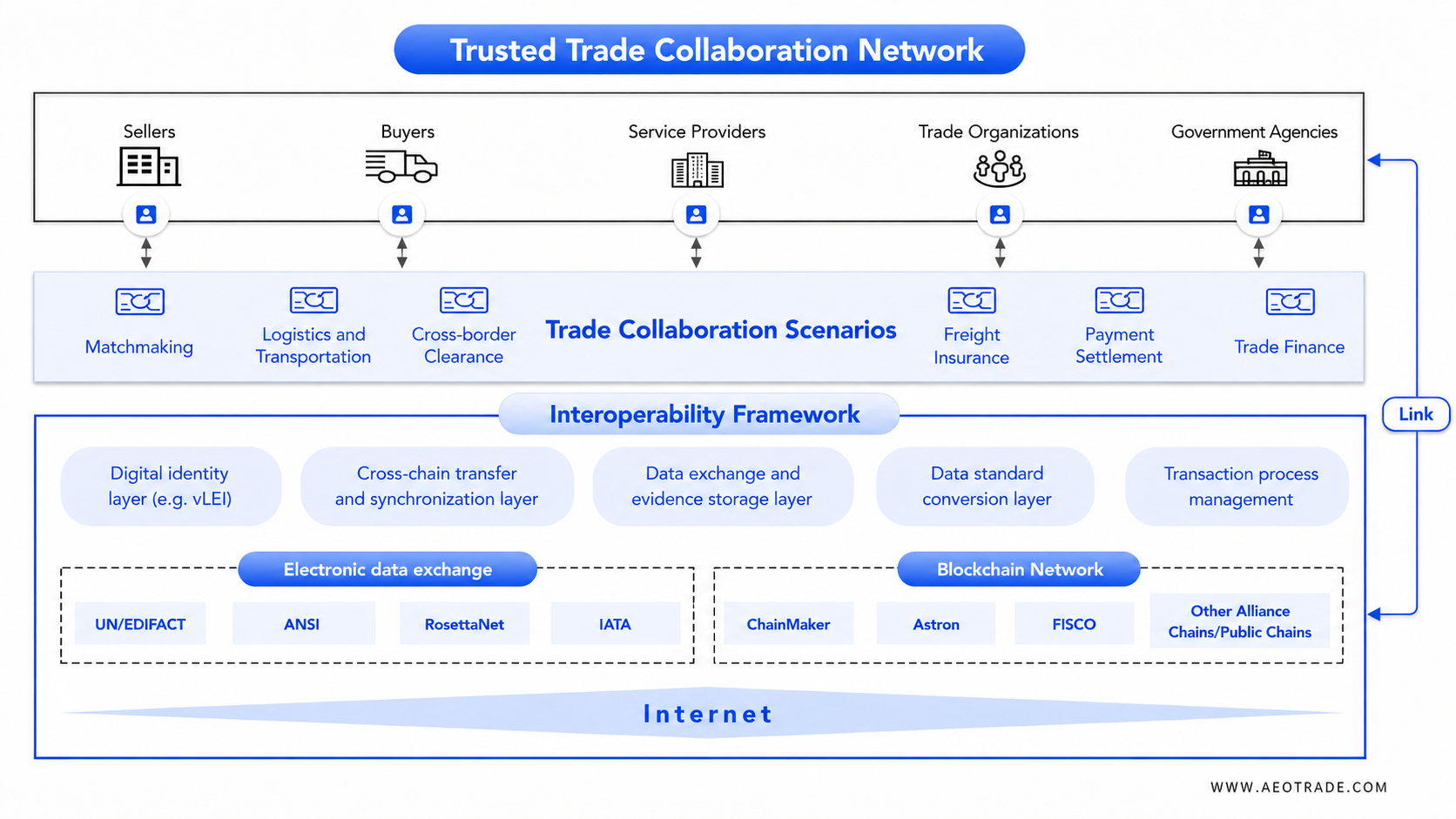
To put this into practice, AEOTrade developed its own digital trade infrastructure: the AEOTradeChain protocol, a global trade interoperability protocol, and AEOTradeChain, an open, distributed, trusted trade collaboration network. Within this architecture, the vLEI serves as the trusted identity layer, confirming each party's identity, while AEOTradeChain supports process collaboration and data exchange. Together, they create an end-to-end trust framework that starts with verified identity and extends to trusted transactions, with the electronic bill of lading (eBL) serving as a key entry point.
Your “AEOTradeChain+vLEI” was awarded at the vLEI Hackathon last year in Hong Kong. How does integrating the vLEI into AEOTradeChain strengthen identity verification and interoperability for eBLs?
Traditional eBL systems often rely on centralized identity authentication. Different platforms cannot easily recognize one another’s identities, and each transfer of title requires manual verification of the parties involved. This is slow and prone to error.
By integrating the vLEI directly into AEOTradeChain, we have introduced three key capabilities:
Identity verification is built in. All participants on AEOTradeChain have digital identities based on the vLEI. Before an eBL is issued, transferred, or otherwise acted upon, the system automatically verifies the validity of the operator’s vLEI. This ensures that only verified legal entities can perform these actions.
Each eBL is linked to the verified identities behind it. Each eBL is bound, through the vLEI, to the identities of the issuer, holder, and transferor. This creates a trusted connection between the person, the credential, and the document, helping reduce risks such as cargo release without an original eBL or duplicate sales.
Platforms can recognize and process eBLs using a common identity framework. AEOTradeChain is compatible with international standards frameworks such as TradeTrust, while the vLEI provides a globally unified legal entity identity reference. This enables trade platforms across different countries and different blockchains to transfer, verify, and use eBLs based on the same identity framework. In real-world business scenarios, this significantly improves the efficiency of eBL circulation and reduces operational costs.
How can the LEI serve as a foundational identity anchor that links national or regional identifiers, digital certificates, and on-chain digital assets to create a globally trusted digital business profile?
The LEI, a globally unique identifier based on the ISO 17442 standard, provides key reference data on the legal entity linked with it. The vLEI builds on this foundation by adding verifiable credential capabilities, enabling legal entities to prove their identities in the digital world in a controlled and entity-governed manner.
Within the AEOTradeChain architecture, the vLEI serves as a global identity anchor, effectively connecting physical business identities with digital transactions.
National and regional identifiers can be linked to a global identity anchor. Many countries have their own business registration numbers or tax identification numbers. Through the LEI, these local identifiers can be mapped to a single global anchor. For example, a Chinese company may have both a Unified Social Credit Code and an LEI. Once the two are linked on AEOTradeChain, overseas partners can complete verification directly through the LEI.
Digital certificates can be tied to verified legal entity identities. Digital certificates used by enterprises for electronic signatures and encrypted communications can be bound and verified through the vLEI, ensuring that the operating party is consistent with the underlying legal entity.
On-chain digital assets can be connected to verified ownership. On AEOTradeChain, each eBL and each trade finance credential is a digital asset. The creation, transfer, and cancellation of these assets are associated with vLEI signatures, making ownership relationships transparent, traceable, and non-repudiable worldwide.
Through this mechanism, the vLEI becomes a foundational trust element that connects legal entities to on-chain activities, supporting a globally recognized framework for trusted organizational identities.
AEOTrade actively participates in China’s digital trade ecosystem, including initiatives such as the Single Trade Window. As China aims to enhance the cross-border interoperability of this and other initiatives, how could the vLEI help connect these regional digital trade innovations with globally interoperable trust frameworks?
China’s international trade Single Trade Window has been operating for many years and has become a core infrastructure for enterprises handling customs clearance and related trade procedures. As a designated operator and service provider of the Single Trade Window initiative, AEOTrade has extensive firsthand experience in this area. However, if regional innovations lack a globally recognized identity foundation, they become difficult to connect seamlessly with overseas partners.
AEOTradeChain is designed as a distributed network connecting regional and global ecosystems, while the vLEI provides a unified identity layer. Looking ahead, several areas could be explored:
Enterprises could obtain a vLEI as part of the Single Trade Window registration process. After completing registration and authentication through a domestic “Single Window,” enterprises could apply for a vLEI simultaneously. This vLEI could then be directly verified by overseas customs authorities, ports, banks, and other parties in cross-border scenarios, eliminating the need to repeatedly submit qualification documents.
The vLEI could provide a common basis for mutual recognition across digital trade corridors. In developing digital trade corridors between China, Singapore, the Middle East, and other regions, participants may use different identity systems. By using the vLEI as a common identity identifier, parties can avoid complex bilateral arrangements and move toward “verified once, recognized globally.”
Regulatory compliance could become more automated and efficient. By linking the vLEI to enterprises’ global trade activity records, customs authorities and regulators can perform risk analysis and compliance reviews more quickly while protecting commercial privacy. This can further improve customs clearance efficiency.
As more countries and regions adopt the vLEI, China’s regional digital trade innovations will integrate more smoothly into a globally interoperable trust framework.
Earlier this year, AEOTrade and GLEIF signed an MOU to promote trusted global digital trade. How does this collaboration enhance interoperability between blockchain-based trade platforms and international trade protocols?
The core purpose of the MoU is to jointly promote the use of the vLEI in digital trade and support alignment between technical standards and international trade protocols. AEOTradeChain is not a single blockchain platform. It is an open, distributed trade collaboration network composed of three elements: the AEOTradeChain protocol, the AEOTradeChain network, and AEOTradeOS. Based on this network, the collaboration between the two organizations will enhance interoperability in several ways:
Technical standards can become more closely aligned and interoperable. GLEIF and AEOTrade will work together to promote interoperability between the AEOTradeChain protocol and GLEIF’s vLEI technical specifications. This will help ensure that core operations on AEOTradeChain, such as identity verification, document signing, and smart contract execution, can natively support the vLEI. Any organization that issues vLEIs in accordance with GLEIF standards will be able to connect more easily to the AEOTradeChain network.
Trade agreement provisions can become easier to operationalize. Many international trade agreements, such as the Digital Economy Partnership Agreement (DEPA) and the Regional Comprehensive Economic Partnership (RCEP), emphasize mutual recognition of electronic documents and paperless trade. Through the vLEI, relevant provisions can be translated into executable automated rules. For example, under the DEPA framework, the identity of the eBL issuer circulating between Singapore and China can be automatically verified via the vLEI, enabling “agreement-driven interoperability.”
Blockchain-based trade platforms can collaborate across chains and ecosystems. As long as different blockchain-based trade platforms leverage GLEIF’s vLEI, they can use AEOTradeChain as a hub for cross-chain identity verification and data exchange. This helps reduce platform silos and enables parties in international trade to establish a shared trust framework.
AEOTrade has already carried out full-process digital trade scenario pilots across industries such as food, automobiles, and home appliances, working with partners in China, Singapore, the Philippines, Tanzania, Saudi Arabia, and other countries and regions. As a next step, the two parties will jointly promote vLEI-based pilot projects to further validate the feasibility of this interoperability framework.
Looking ahead, what new use cases could emerge from combining trusted organizational identity with digital trade documentation and supply-chain workflows?
Together, AEOTradeChain and the vLEI provide a trusted digital foundation that could make trade workflows more automated, interoperable, and secure. This creates opportunities for new use cases in areas such as smart contract-driven trade finance and on-demand trusted collaboration networks:
Trade finance could become more automated through smart contracts. When banks can verify the identities of buyers, sellers, and logistics providers in real time through the vLEI and access trusted documents such as bills of lading and invoices anchored on-chain, trade finance can become an automatically triggered smart-contract process. For example, financing could be released automatically upon issuance of a bill of lading, and repayment could be executed automatically upon transfer of title to the goods. This would significantly shorten financing cycles and reduce operational risk.
Businesses could create trusted collaboration networks on demand. Based on a vLEI-enabled digital identity, enterprises can dynamically create temporary trade collaboration groups to meet business needs, such as for an order involving manufacturers, logistics providers, inspection agencies, and insurers. The identities of all participants can be easily verified, permissions automatically assigned, workflows automatically orchestrated, and the group automatically dissolved once the transaction is completed. This flexible, efficient, and trusted collaboration model can greatly reduce customer acquisition and collaboration costs for enterprises.
AEOTrade has already begun exploring these scenarios. We believe that as the vLEI becomes more widely adopted, these innovations will move from pilots to scaled deployment, ultimately helping the global trade system evolve into a more efficient, transparent, and inclusive digital ecosystem.
If you would like to comment on a blog post, please identify yourself with your first and last name. Your name will appear next to your comment. Email addresses will not be published. Please note that by accessing or contributing to the discussion board you agree to abide by the terms of the GLEIF Blogging Policy, so please read them carefully.
Zetao Yang is the Founder of AEOTrade and Secretary General of the TradeTech Alliance. A graduate of Wuhan University, he previously worked at the Logistics Engineering Research Center of the Ministry of Transport of China and the Data Center of the General Administration of Customs, among other institutions. He participated in China’s logistics informatization planning and the development of the E-Port system, contributing to the advancement of logistics and customs clearance informatization in China.