Planned maintenance: Brief service interruptions may occur between 19 October and 4 November 2026.
News & Media
GLEIF Blog
Unlocking the Full Potential of European Business Wallets with the LEI
As a digital compliance layer within European Business Wallets, the LEI supports trusted organizational identity, connects compliance requirements across financial services, and enables more efficient cross-border business interactions.
Author: Alexandre Kech
Date: 2026-06-02
Views:
The European Commission intends for the European Business Wallet (EBW) to become a foundational component of Europe’s digital economy and a springboard for its growth from 2028 onwards. This is when EU-wide adoption is expected to begin.
The EBW is a core element of the Commission's digital package, announced in December 2025, which aims to help EU businesses spend less time on administrative work and compliance and more time innovating and scaling up. The EBW is a 'harmonized digital solution' that will offer companies a single digital identity to simplify paperwork and make it much easier to do business across EU Member States.
Businesses that use the wallet will be able to digitize many operations and transactions currently conducted manually. The following actions can be conducted digitally, with full legal effect across all 27 EU Member States:
Counterparty identity can be checked, and one's own identity can be proved instantly.
Trusted documents can be created, stored, and shared in real time, such as verified licenses, permits, certificates, and more;
Documents can be digitally signed, timestamped, or sealed;
Delegations can be made so others can act on a company's behalf in a legal capacity;
Communication can take place with other businesses or public administrations via a secure and efficient channel.
Yet while public-sector bodies will be legally required to accept EBW-based identities under the EUDI Framework, private-sector adoption of the EBW will be driven by measurable operational efficiencies.
For this reason, the EBW must demonstrate tangible value to businesses if it’s to be successful.
On the surface, it might be challenging to understand how the EBW could offer only limited value. After all, it's easy to see the enormous potential for cost and time savings in enabling automated, secure, and scalable business processes across EU borders.
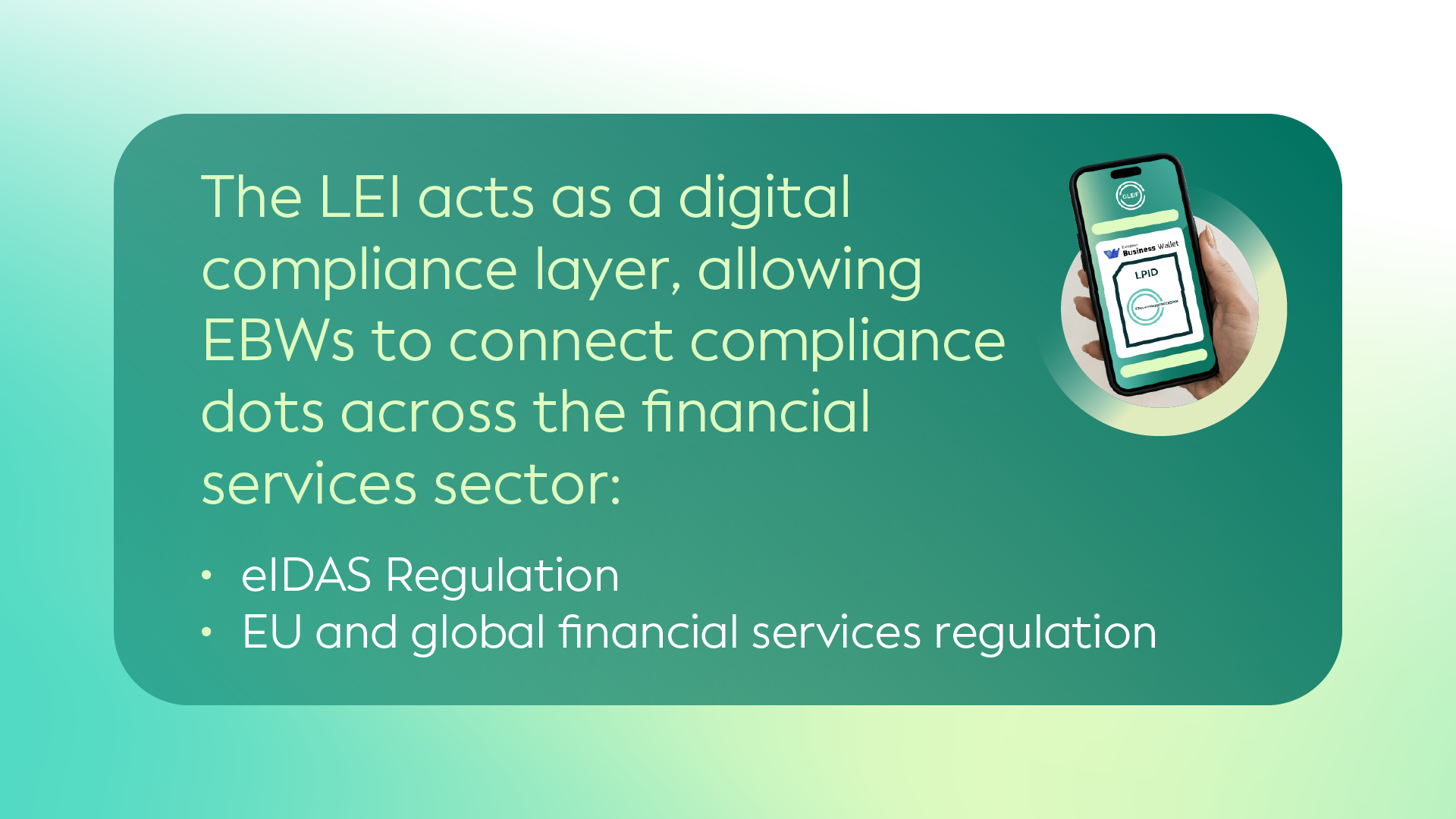
Yet for corporate treasurers and financial institutions in particular, there is a separate critical function that the EBW must fulfill if it is to become an essential identity tool in facilitating their day-to-day operations and obligations. As a central component of Europe's new trust services framework, EBWs must allow them to connect the identity compliance 'dots' - across eIDAS, EU, and global financial services regulation. And with the LEI permanently embedded in EU and global financial services regulation as an obligatory compliance layer for entities wishing to engage in or facilitate financial transactions, the LEI's presence as an identity attribute within the EBW is essential. The LEI is central to creating wallet-based value for European corporate treasurers and financial institutions.
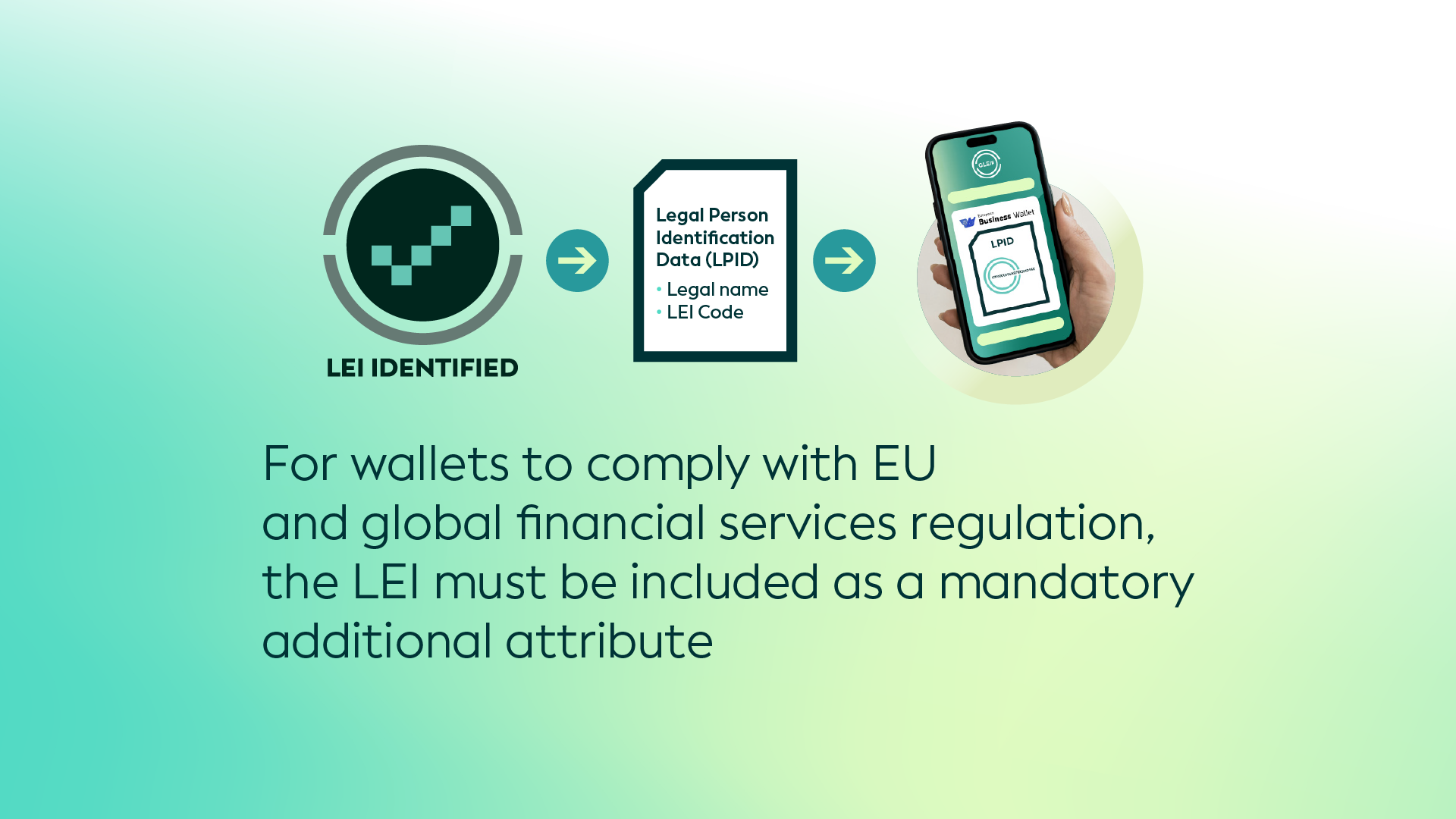
The LEI must be a mandatory additional attribute within EBWs
Within the EUDI framework architecture, the LEI is recognized as an entity identifier that may be included in Legal Person Identification Data (LPID). However, its optional status does not guarantee its inclusion in EBWs. This decision will be made by EU Member States as they develop their national wallets.
So, what is the importance of ensuring the LEI is a mandatory additional attribute within EBWs?
Corporate treasurers and financial institutions should be aware of the following benefits that only the LEI can deliver within this context:
Compliance with EU and global financial services regulation
The LEI is an established pillar of trust within financial services. EU authorities and financial supervisors worldwide have integrated it into their financial services regulation to ensure safe, transparent, and well-functioning financial marketplaces. It is also a tool to monitor systemic risk, which can inform decisive action to prevent market-related crises. It links organizations to an open, verified, and high-quality reference data set, supporting transparency across financial ecosystems. Importantly, the LEI is not limited to a European context. It is recognized and referenced by regulators and authorities across jurisdictions worldwide, making it uniquely positioned to support cross-border digital business.
By acting as a digital compliance layer within the EBW, the LEI can elevate the wallet’s value as an essential identity tool for corporate treasurers and financial institutions. It helps connect the compliance dots across onboarding, payments, capital markets, transaction reporting, and anti-money laundering requirements, not just in the EU but on a global stage too.
Onboarding efficiencies
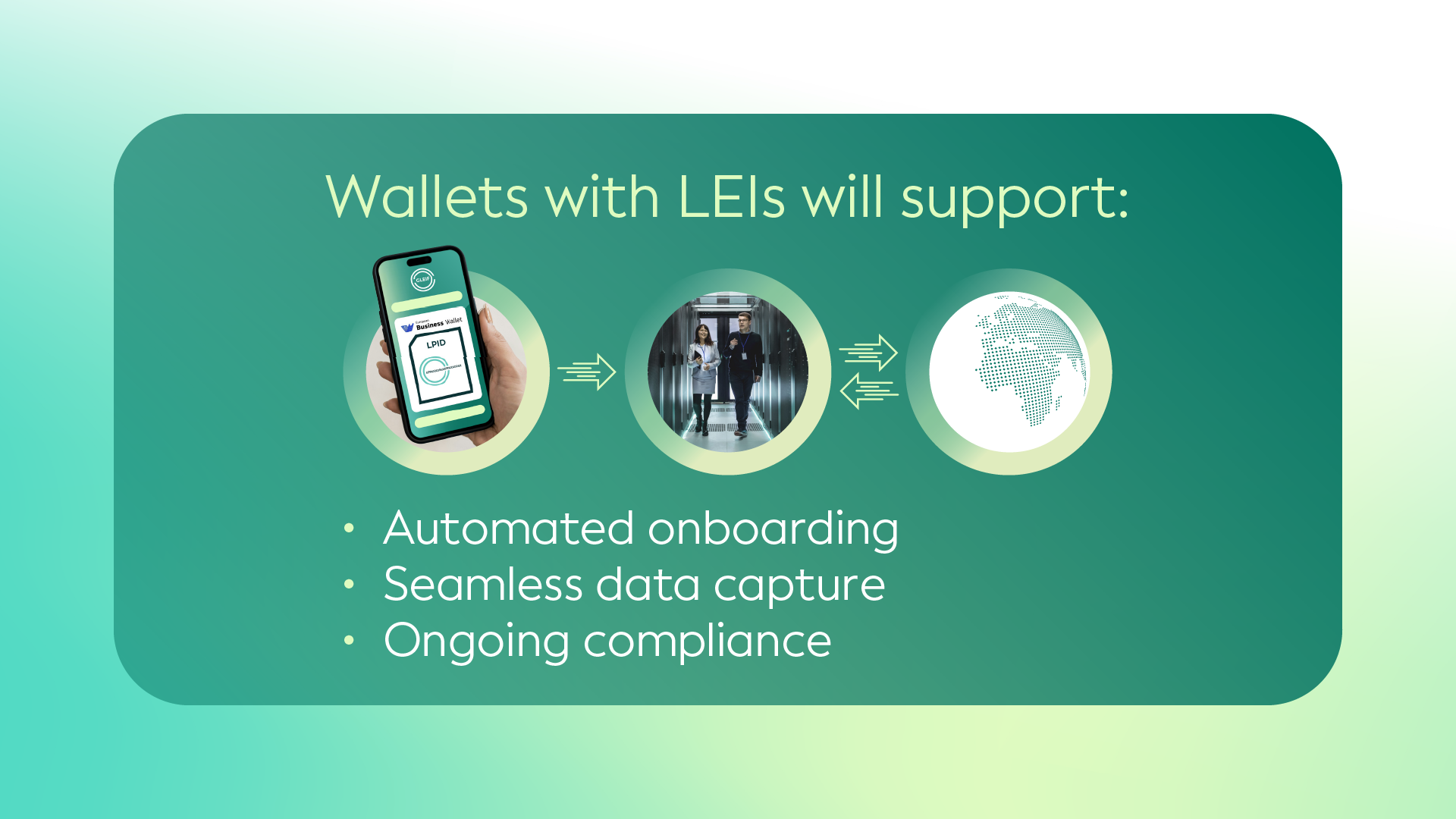
Traditional onboarding and KYC processes still rely heavily on manual verification, causing delays, operational friction, and duplication. Embedding the LEI in an EBW credential enables automatic extraction of verified entity data and access to continuously updated reference information through the Global LEI Index. This shifts onboarding from fragmented document exchange to a reusable digital trust model. Organizations can rely on a consistent, interoperable identity layer instead of repeatedly verifying the same company information across systems and counterparties.
Enhanced downstream financial transactions
The benefits of embedding LEIs within EBW credentials extend well beyond compliance and onboarding. The presence of the LEI can help reduce fraud in payment verification, enable automated reporting to market infrastructures, and streamline eInvoicing workflows. Instead of fragmented identity verification across separate systems, organizations can rely on a universal, reusable, and interoperable trust mechanism. This becomes increasingly important as digital business ecosystems grow more interconnected, and a trust infrastructure is needed to operate seamlessly across borders and industries.
Future-proofing the EBW
Embedding the LEI within EBWs also future-proofs the wallet for emerging digital use cases. LEIs stored within EBWs can support the automated generation of verifiable LEI (vLEI) credentials, enabling stronger cross-border interoperability and higher-assurance digital interactions. This is particularly relevant for areas such as digital assets, supply chain ecosystems, and automated B2B transactions, where trusted organizational identity is essential for reducing risk and enabling scalable automation.
As Europe advances its digital identity and trust services framework, technical decisions being made today will shape how effectively businesses can operate tomorrow. For corporate treasurers and financial institutions, the message is clear: the EBW will deliver its greatest value when it reflects the identity and compliance needs of the sectors that will use it. Embedding the LEI within EBW credentials is not just a technical design choice. It is central to making the wallet useful for real-world business interactions. Businesses preparing for the EBW should ensure the LEI is included in their digital identity strategy.
If you would like to comment on a blog post, please identify yourself with your first and last name. Your name will appear next to your comment. Email addresses will not be published. Please note that by accessing or contributing to the discussion board you agree to abide by the terms of the GLEIF Blogging Policy, so please read them carefully.
Alexandre Kech is the CEO of the Global Legal Entity Identifier Foundation (GLEIF).
Prior to joining GLEIF, Alexandre Kech was Head of Digital Securities at the SIX Digital Exchange. As a member of the Executive Board, Alex had full executive responsibility for the Digital Securities business vertical, including sales and relationship management, product development, business design, and ecosystem expansion.
Over the past 25 years, Alex has constructed a unique career combining finance at BNY Mellon, payments/securities infrastructure and standards at SWIFT, and blockchain and digital assets at Onchain Custodian (ONC) and, most recently, Citi Ventures. As co-founder and CEO of ONC, Alex led the Singapore and Shanghai-based team that built custody and prime brokerage services for crypto and other digital assets from scratch. As Blockchain & Digital Asset director at Citi Ventures, he built a team to engage the European ecosystem on emerging use cases for blockchain technologies and digital assets.
Alex is also involved in industry and standardization initiatives. As the convenor of the ISO TC 68 / SC8 / WG3, which produced the ISO 24165 Digital Token Identifier (DTI), he is a member of the DTI Foundation Product Advisory Committee. He also recently served as co-chair of the Global Digital Finance (gdf.io) custody working group.
Alex earned a bachelor’s degree in translation and an Executive MBA from the Quantic School of Business and Technology while building Onchain Custodian, putting theory into practice in real-time.